Feast of the Holy Family

There are a myriad of biblical threads which could be traced in today’s Liturgy of the Word: blessing, promise, mutual obedience in family life, faithfulness to the Law, joy and sorrow. Add to that the opening Collect and the other prayers of the Mass and the picture which emerges is something a little more complicated than the name of the feast suggests.

While it’s possible to weave together a very pious set of ideals about family life from liturgy and tradition, I like to see today’s feast as a time to acknowledge the joys and sorrows of living in relationship with others. We are made for connection, however fragile that may feel. In family life or community life you have to take the rough with the smooth. God uses it all.

I take courage today from the last lines of the Gospel; ‘His mother stored up all these things in her heart.’ This is one of the invitations of today’s feast: store up the moments of grace and insight. God will use it.

Advent Alphabet (Z)

We have journeyed throughout Advent with the people of Israel. We have followed their joys and sorrows. With them we have held fast to the promise that out of desolation God will bring hope and joy. We have attuned our ears to God’s word. We have listened to words of comfort and of challenge.

In a series of uncompromising prophecies Zephaniah holds Israel to account and warns of the destruction of Jerusalem. As with all prophetic literature you have to take the rough with the smooth. Alongside the warnings there is hope for a small group of faithful people:

Seek the Lord all you humble of the land,
who have observed his law.
Seek justice, seek humility.

A time of rejoicing is drawing near and Zephaniah uses the metaphor of Jerusalem as a daughter, who is called upon to rejoice:

Sing aloud,
O daughter of ZION;
shout, O Israel!
Rejoice and exult
with all your heart,
O daughter of Jerusalem!

In some of the most vibrant and beautiful imagery in prophetic literature Zephaniah tells us of the depth of God’s joy over the daughter of Zion:

He will exult over you,
he will renew you by his love:
he will dance with shouts of joy for you
as on day of festival.

We probably don’t spend enough time imagining God exulting over us and dancing with joy for us. This same joy and delight lies at the heart of the Incarnation. Whatever the joys and sorrows you have experienced this Advent, tonight we gather to celebrate the power of light and love in God’s gift of Jesus to our world.

How have you been renewed in God’s love on this Advent journey?

(Zephaniah 3:14-18, Sunday 3, Year A)

Advent Alphabet (Y)

YOUNG MEN

This Scripture verse always takes me back to my early 20s and memories of the combinations of things that I just took in my stride. Suddenly falling exhausted was quite a rarity. It’s an entirely different matter now.

The context for Isaiah’s words is the promised return from Exile in Babylon, a theme we have visited several times this Advent. The exiles feel themselves abandoned, alone and utterly exhausted. What is being offered is a vision of a world re-ordered with God’s energy and power. God is neither tired nor exhausted. Young men may fall exhausted but God never will. A new world of hope and possibility awaits the exiles.

Perhaps by this time in Advent you have reached the point of exhaustion.
Perhaps you are wondering if your strength will last.

How do you hear Isaiah’s promise?
What might it mean for you today?

(Isaiah 40:25-31, Wednesday, Week Two)

Advent Alphabet (X)

CHRIST
Χρίστος

‘This is how Jesus CHRIST came to be born.’

Matthew begins his gospel with a lengthy genealogy which requires great concentration, whether you are listening to it or reading it aloud. It’s not unlike having a complicated story plot explained or trying to work out how you are related to a distant relative. The lineage which Matthew lays out so carefully is our lineage too. We are as much reliant on God’s promise as our Biblical ancestors.

Matthew tells his story through Joseph’s eyes. Joseph’s Davidic descent is all important here. This descent, so carefully explained, embeds Jesus very firmly in Jewish tradition. Two leaps of faith are required for God’s plan to come to fulfilment: Mary’s ‘yes’ and Joseph’s willingness to be a father to Jesus.

We are almost at the end of our Advent journey. The path of promise that we have traced through the Scriptures doesn’t come to an end with Christ’s birth. The unique story of how each of us came to be born stands alongside the birth of our Saviour. God still waits for our ‘yes’ and our willingness to enter deeper into the mystery of the Incarnation.

Look back over Advent.
How have you been drawn deeper into the mystery of the Incarnation?

(Matthew 1:18-24, 19th Dec)

Advent Alphabet (W)

WILDERNESS

Let the WILDERNESS and the dry-lands exult,
let the wasteland rejoice and bloom,
let it bring forth flowers like the jonquil,
let it rejoice and sing for joy.

Over the years I have had a number of friends from missionary Religious Orders. One of them in particular brought this passage of Isaiah alive by talking about the startling transformation of the desert in the rainy season. Tiny bursts of colour would appeared in a landscape that had been dry and unchanged for months.

In Isaiah’s theology the blooming of the desert is entirely God’s initiative. The Israelites have done nothing at all to bring this about. They are simply to be the witnesses of God’s glory. That the most arid areas will enjoy the new life and abundance of Lebanon, Carmel and Sharon is the cause of great joy.

We are familiar with wilderness as a metaphor, not just in biblical literature. I am often struck by the fact that what one person experiences as ‘wilderness’ might not be experienced in the same way by another. We can help each other to see those tiny bursts of colour in what feels dry and arid in our daily lives. God can use it all.

Has anything new blossomed in your life this Advent?

(Isaiah 35:1-10, Tuesday, Week Two)

Advent Alphabet (V)

VALLEY

Let every VALLEY be filled in, every mountain and hill be laid low…

In Chapter 40 Isaiah announces with great urgency Judah’s triumphal return from exile in Babylon. What was once a valley will now be filled in. There will be no need to scale a mountain either as these will be laid low. Nothing is to bar the way of Judah’s joyful return to Jerusalem. On a newly built highway Judah will run like a runner in a race.

Judah has known the peaks and troughs in her relationship with God. She has been to the mountain top and seen God’s glory. She has sat despondent in the valley and doubted God’s presence. She has been brought so low that now it’s God’s initiative alone that will save her.

As we come near to the end of Advent can you look back and see your own valleys?
How has God filled in the valleys for you?

(Isaiah 40:1-11, Tuesday, Week Two)

Advent Alphabet (U)

That day, this song will be sung in the land of Judah: We have a strong city;
to guard us he has set wall and rampart about us. Open the gates! Let the UPRIGHT nation come in, she, the faithful one whose mind is steadfast, who keeps the peace, because she trusts you.

The people of Judah lived in precarious circumstances with the threat of Assyria looming. Isaiah preaches a message of trust in God alone and warns against alliances with other nations.  Walls, ramparts and gates are the physical signs of God’s protection. The would-be invader or attacker needs a strategy to get through these protections. Judah can feel safe with these things in place.

Isaiah imagines the triumphal entry of Judah into the safe and protected city. It’s the upright nation and the faithful one who will walk through the gates and be assured of God’s presence. It’s those ‘whose mind is steadfast’ and those who ‘keep the peace’ who now walk through the gates. ‘Upright’ and ‘faithful’ are short-hands for living in relationship with God, for following the Law in word and deed.

As the story of our salvation has unfolded this Advent we have met the upright. These are the people who have put their trust in God’s promise and walked in his ways. They were humble enough to know their need of God.

Who are the ‘upright’ in your own life?
What have they taught you?

(Isaiah 25:6-10, Tuesday, Week One)

Advent Alphabet (T)

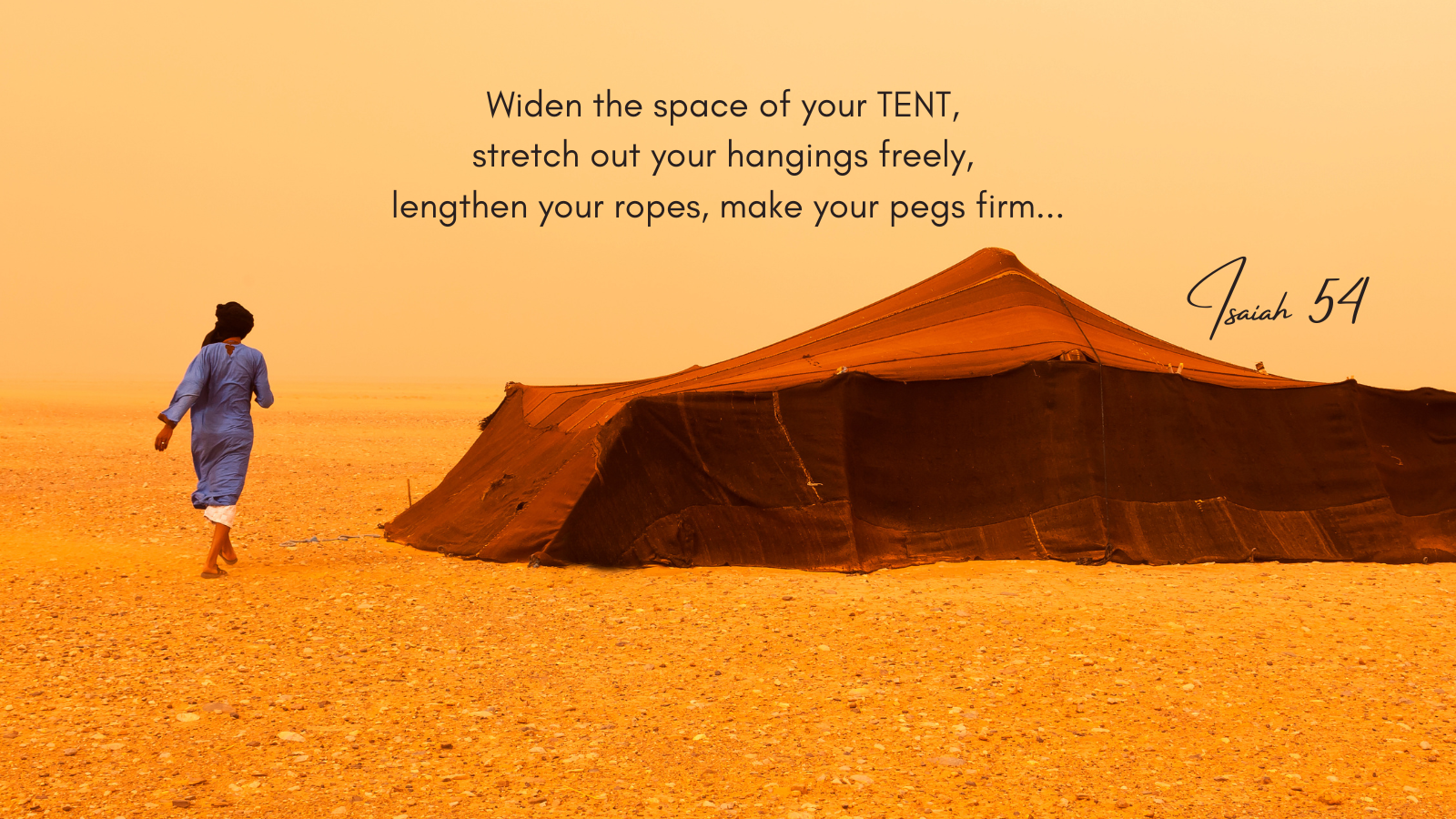
Widen the space of your TENT,
stretch out your hangings freely,
lengthen your ropes, make your pegs firm…

I have always loved this text. The hope and possibility in the image of strengthening and expanding a tent have sustained me in some times of wilderness. In Isaiah Ch 54 these verses are preceded by a lament for Israel as a barren woman. Her fortunes are about to turn, she is going to need more space, she will be blessed with children.

Isaiah now takes up the familiar refrain of Israel’s experience of exile, shame and abandonment and promises a future more blessed than could ever have been imagined. It’s God’s everlasting love and faithfulness (hesed) that makes this possible.

When we hear this text in Advent we too are invited to widen the tent of our lives and to make space for God’s blessing. All of this is made possible through the wideness of God’s love, made flesh in Jesus.

As we come to last few days of Advent, how is God calling you to make space for his blessing?

(Isaiah 54:1-10, Thursday, Week Three)

Advent Alphabet (R)

REJOICES

I exult for joy in the Lord,
my soul REJOICES in my God,
for he has clothed me in the garments of salvation,
he has wrapped me in the cloak of integrity,
like a bridegroom wearing his wreath,
like a bride adorned in her jewels.

In the three books which make up the writings ascribed to Isaiah the theme of God’s saving actions sounds loud and clear. There is good news to be heard: the time of suffering is coming to an end, God will send the Holy One and the whole of creation will be restored. If this good news is received by a faithful people they will find themselves comforted and their wounds healed.

That God’s promise is about to be fulfilled is the cause for exuberance and rejoicing. The clothing metaphor speaks to me of the security and protection that God’s promise brings. The festive wedding adornments of wreath and jewels speak of a joy that has a special intensity. This joy is shared with all who gather to celebrate a wedding.

When Mary sings her Magnificat there is a sense in which she gives voice to all the joy that Israel has ever experienced. When her ‘spirit rejoices’ it does so in thankfulness for the ways in which God has acted in covenantal relationship with Israel. This joy fills Mary’s whole being.

Where have you seen God’s promise unfold?
Are there things for which you can rejoice this Advent?

(Isaiah 61:1-2, 10-11, Sunday 3 (B)

Advent Alphabet (Q)

QUICKLY

I have always loved the urgency in Luke’s story of the Visitation; ‘Mary set out and went as quickly as she could to a town in the hill country’. By all accounts Mary’s journey to Elizabeth won’t have been easy. That Mary loses no time in making her journey speaks of the power of God’s promise in her life. Mary’s life rests on three foundation stones: God’s Word (Torah), God’s Service (Prayer), God’s Work (Kindness). There is a sense in which all three of these compel her to make the journey.

Whatever we imagine the terrain to be like, the journey was long and not without danger for someone Mary’s age. Luke gives us none of the details of the journey, focusing instead on the joy of Mary and Elizabeth meeting and recognising each other as vessels of God’s will.

Urgency can be a difficult thing to navigate in our daily lives. So many things can make an urgent call on hearts and minds. The urgency of love is a different matter. We probably all have in our lives people for whom we would drop everything and go ask quickly as we could.

Which things compel you?
Where is God calling you to go quickly this Advent?

(Luke 1:39-45, Dec 21st)