I have always loved this line from Luke’s account of the Birth of John the Baptist. The reader knows just who he will turn out to be. And yet, I am always caught up in a feeling of expectancy and possibilities. An earlier line in the account kindles a similar feeling of expectancy for me:
The time came for Elizabeth to have her child, and she gave birth to a son; and when her neighbours and relations heard that the Lord had shown her so great a kindness, they shared her joy.
This longed-for child is already surrounded by a network of love and joy. I’d like to think that it is from this implicit place of security that John was able to make his radical choices and follow a path that would eventually lead to martyrdom. No parent would wish this for their child, and yet, there Elizabeth and Zechariah stand as models of righteousness and faith. Their trust in the power of God’s promises was truly tested.
I have to confess to being a little unnerved by many of the portrayals of John the Baptist that I have seen on films etc. There is always an element of the ‘wild man’ about him. And the puzzling detail of surviving on locusts and wild honey can make it very hard to identify with him on a human level. (Now the leather belt and sandals are a different matter, as they are part of my everyday wardrobe!) I can however identify with the clarity of his preaching. That one word, REPENT, change of heart, is the essence of the Benedictine vow of Conversio Morum. It’s a daily call to reorientation and to making space for God. It’s through this vow that I have the opportunity to grow a little more each day. In truth, we never stop growing and never stop asking of ourselves: ‘What will this child turn out to be?’ And, thankfully, what’s not always clear to us, is always clear to God.
Over these past few months many of us have had to adjust to some very challenging routines. We’ve lost the markers and structures that subtly orient us. If attending a church service on a Sunday was something that had become a habit, then that loss is perhaps felt on more levels than you might have expected. In many ways, the absence of the opportunity to gather physically in a church has provided an important opportunity to be creative in our understanding of prayer, worship and community. That opportunity to be creative isn’t always a place of comfort. It can often appear to offer more risk than comfort.
Uncomfortable though it may be, we have a golden opportunity to look afresh at our rituals, to examine how we use a liturgical space and to try to uncover what is essential in our worship. It’s no small task. And as any monastic will know, re-assessing liturgical practice touches us at a level that can be hard to articulate. We can know viscerally that we hold something very dear but be unable to put it into words.
From my monastic context I have come to experience the Psalms as one of the essentials of my prayer. When I think back to the time when I first discovered Turvey, it was the poetry of the Psalms that captivated me. As I took my first steps on the monastic path it was the images of the Psalms that kept me company. For there in the Psalter I found a tree ‘whose leaves shall never fade’, ‘a rock of refuge’, ‘silver from the furnace’. Here was a world with image upon image, a world which included and celebrated the complete spectrum of human emotions. In those early days I had an intuitive sense that it was in this Biblical world that I might find my path.
Praying the Psalter has certainly stood the test of time. Some form of the Psalter has been part of public corporate worship from the very beginnings of Church life. Monastic tradition embraced this practice and over centuries it grew and flowered. St Bede in the 7th Century is in no doubt as to the place of the Psalms in his life. St Bede would have credited King David with the authorship of the Psalms and in a stirring sermon says this:
If we keep vigil in the church, David comes first, last and central. If in early morning we chant songs and hymns, first, last and central is David again. If we are occupied with the funeral solemnities of those who have fallen asleep, David is first, last and central.
It’s a beautifully uncomplicated vision. And strikingly exposure to the Psalms is not just the preserve of monastics:
O amazing wonder! Many who have made little progress in literature know the psalter by heart. Nor is only in cities and churches that David is famous, in the village market, in the desert, in uninhabitable lands or if girls sit at home and spin, he excites the praises of God.
There is something very compelling for me about this vision of texts learnt by heart and repeated while doing the ordinary tasks of the day. It may well be idealised, but is says something to me about integration and sacredness being woven through the day.
It looks as though it may be a very long time before it is safe for communities to come together and celebrate the Eucharist. I wonder if in that void we might be able to make a place for the Psalms? I wonder if we could allow the Psalms to be our voice? Much of the hard work of ‘what to say, and how to say it’ is done for us. We can walk a path that has already been smoothed out for us, where there are signposts and resting places, green pastures and bread to strengthen our hearts.
Read a Psalm a day and before long they may become ‘first, last and central.’
I often surprise people by sharing that I have taken Leviticus as my Lent book two years in a row. When I see a look of disbelief and puzzlement on people’s faces it only makes me all the more enthusiastic. The trouble is that in order to explain why it fascinates me so much I would need to give a mini lecture and would definitely need something visual to be sure of getting my points across. Understandably, nobody wants to hang around that long. The fact remains that I really do love this text.
At first sight, Leviticus reads as a complex handbook for rituals and ways of living that are at best peculiar and at worst very off-putting. But what if we took one verse as our hermeneutical key: Love thy neighbour as thyself (Leviticus 19:18). This verse comes from Ch 17-27, known as the Holiness Code. This code comes at the end of Leviticus and provides a lens through which to view the preceding chapters.
The endless details of the sacrificial system, the food laws and purity laws all have one goal and that is unity and LOVE. Leviticus is edited and shaped into its final form during the period of the Exile. This was a period of soul searching and dislocation for the Israelites. Faced with the feeling of confusion as to what the covenantal promises could possibly mean now, the Priestly circle of writers outline a code that is intended to safeguard love and restore hope. The Israelites are in a relationship crisis.
The writers are of the mind that worship is key for Israelites in their longing to restore right relationship with God. Their worship is to have order, shape and form and these are the hallmarks of holiness. The Hebrew word they use for holiness is kadosh, a word that means set apart. Writ through every aspect of their lives is need to create boundaries and to ‘set things apart’. The Hebrew thinking is that the desire and ability to do this mirrors the work of God in Genesis who ‘divides light from darkness’.
Oratory at Turvey Abbey
Probably part of my fascination with Leviticus comes from my years of learning the ropes of the monastic path. Monastic life of its nature places a very high value on order, shape and form. I think it would be fair to describe it as a life ‘set apart’. It is also a life that is intentional. Of course, there are ways of organising that are just sensible, but many of the ways in which we try do things have charity and love of neighbour at their heart.
Having an overall structure for every day of the year more or less ensures that we know what is coming next and what we should be doing. I’ve read a great many posts about how to survive lockdown and all of them mention a routine. Of course, I agree with this in principle, but I would like to add a caveat. Don’t be afraid to change that routine if it isn’t working. In his Rule St Benedict lays out several ways of organising life in the monastery, but wisely adds that if an arrangement is found to be unsatisfactory, the abbot ‘should arrange whatever he judges better’. (RB Ch 19)
You will probably have found by now that you need to factor in some untimetabled time. I think its important to allow some time for ‘freefall’ because it is during that time that your learn about yourself. It seems important that we allow ourselves to experience that restlessness that comes from having spent several hours in escapism. Our monastic ancestors, the Desert Fathers and Mothers, knew this restlessness well and called it acedia. Not only did they know this feeling well, they also suggested a potential cure: clean out your cell. Yes, pretty much every malady could be helped by manual work. It’s just possible that this could be a great help to us during lockdown. Any small area where we can create outer order has the potential to create a little ‘inner order’ and contentment.
I am sure that many of us are learning that having to be in the same physical space with others for long periods of time is a huge challenge. I think this might be where the idea of boundaries and ‘things set apart’ might help us. In the busyness of everyday life many boundaries have subtly been eroded. The pace of life demands for many that they take their ‘lunch break’ at the computer screen and answer emails on their commute. Perhaps this time of lockdown could help us to identify where our own boundaries have blurred and to reset them if that is possible. The idea of boundaries also has something to say to our relationships and how we share physical space with others. I am often sitting with a question myself: How do I make space for others? It is just possible that respecting the physical space of another allows them some psychological space too. These things are rather subtle and no two people are the same.
Whatever our circumstances during this lockdown, there is a deep call to make space for others, to love the neighbours we have discovered and the parts of ourselves that often lie hidden. This is Holiness.
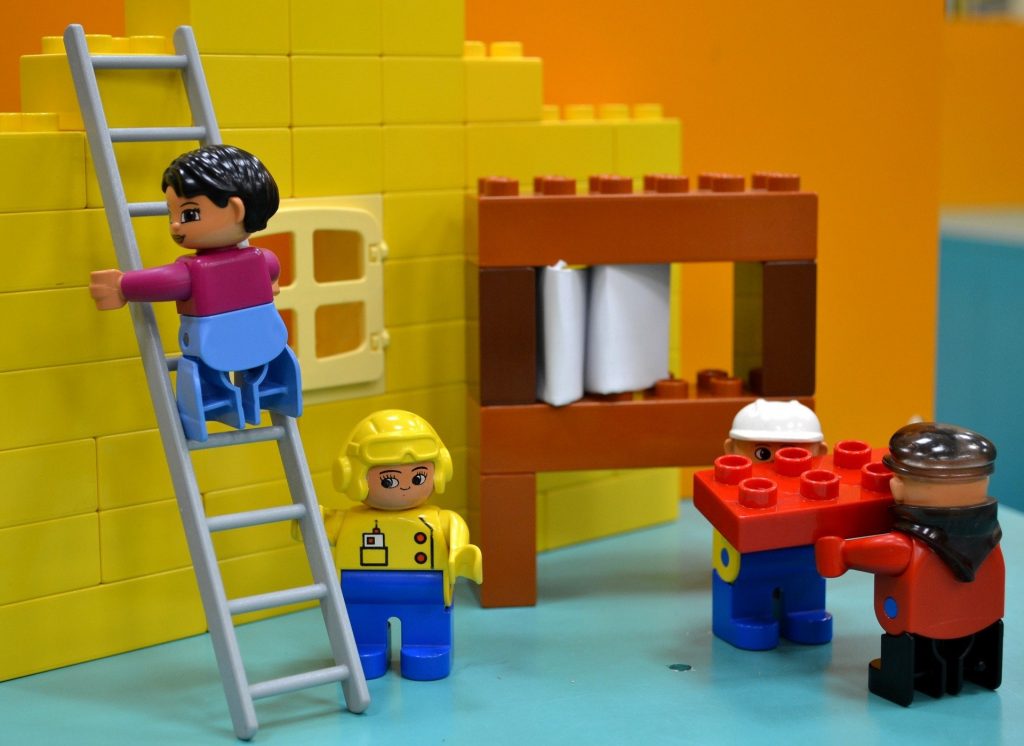
It’s from the Danish words ‘lege godt’ that we get the brand name Lego. These two words hold a whole philosophy and it is one which formed a crucial part of my childhood. As a small child I was never happier than when I was tipping out my Lego collection and searching for the pieces for my latest project. I remember a huge sense of freedom as I created my structures- usually huge houses. There was something very satisfying about making a brickwork pattern and getting the roof tiles to fit. I am not by temperament very good at following instructions, so when Lego brought out Lego Technic it was my younger brother who had a whole new avenue to explore.
I have read quite a few online articles on how to survive lockdown, but I don’t think any of them have mentioned the importance of play for adults. There is mountains of research on child development and the importance of play for children, but I wonder how much research there is on adults and play? It is easy to think of play as something that should finish in childhood, in order to make way for the serious business of being an adult.
I have been very influenced over the past few years by the work of Brene Brown, a social worker who has spent time researching Shame and Vulnerability. At the heart of her research is her discovery that there is a group of people who are resilient to shame and these she calls ‘ the wholehearted’. What the wholehearted have in common is their capacity for play and creativity. Brene honestly admits that in the past she has had very little time for the creative. One of my favourite lines from her talks is where she tells of a friend inviting her to an art class. Brene thinks to herself; ‘You go do your A.R.T, I have a J.O.B.’ Brene reveals that she has had to eat humble pie and begin to explore her own creative avenues.
One of the things that monastic life has taught me is the importance of accessing my own creativity. My monastery is a very creative environment, with a history of all kinds of handwork. There is something about the monastic structure and environment that draws out your resourcefulness and opens up the possibility of play. We have cupboards and drawers full of all kinds of things just waiting to be played with.
If you are finding you are going a little stir-crazy being in a small space and trying to follow some kind of routine, perhaps now is time to schedule in some playtime. Brene Brown defines play as ‘time spent without purpose, where you lose track of time and engage in an activity that you don’t want to end’.
In these days of lockdown and uncertainty I am finding myself grateful for all of the resources at my disposal, material and spiritual. I’ve become very aware of the good fortune of living in community and of a monastic system of housekeeping which means that our storeroom shelves and freezers are always 3/4 full. We try to live a spirit of simplicity and can often make a little go a long way. But it always feels as if we have plenty.
Benedictine life has an innate sense of the importance of the material. In his Rule, St Benedict urges his community to ‘treat the good and tools of the monastery as the vessels of the altar.’ In just a few words St Benedict has laid part of the foundations of a way of life that has been lived, in various forms, since the Sixth Century. For St Benedict daily life in the monastery was all of a piece: the material, the implicitly spiritual and the explicitly spiritual are woven together into something very robust.
During the past month my sense of my dependence on material things has been heightened. Those bars of soap that I have been given as presents during the year are special now. They are special because they came from friends and special because now they can contribute to my health and safety.
My awareness of my dependence on the implicitly spiritual and explicitly spiritual has also increased. We haven’t celebrated the the Eucharist in our chapel since March 21st. It was a shock to the system and it has set off for me a train of thought that runs ‘what if we didn’t have…’ What if we didn’t have a chapel? What if we didn’t have the Breviary? What if we didn’t have Bibles? As I have let these thoughts run I have realised that I am so grateful for the parts of scripture that I know by heart. After 25 years of singing the liturgy there are many texts that I can sing by heart. This feels like a precious inner resource for me.
During the Easter Octave we sing this Canticle at Lauds and Vespers:
When we were baptised in Christ Jesus, we were baptised in his death.
When we were baptised we went into the tomb with him, and joined him in death.
So that as Christ was raised from the dead by the Father’s glory, we too might live a new life.
If in union with Christ we have imitated him in death, we shall also imitate his resurrection.
Our former selves have been crucified with him, to free us from the slavery of sin.
We believe that having died with Christ we shall return to life with him.
Christ, having been raised from the dead, will never die again; death has no more power over him any more.
When he died, he died once for all to sin, so his life now is life with God.
And you too must consider yourselves dead to sin, and alive for God in Christ Jesus.
Romans 6
I have always loved Romans. This text is one of the touchstones of our faith. It’s also a touchstone of monastic theology which sees the whole monastic path as a dying to self and a rising to new life in love and communion. And the goal of it all is to be ‘alive to God.’
When each day we hear of the death toll rising and hope ardently that the Corona Virus will have reached its peak, it seems all the more important to cherish life and make every choice one that says; ‘I am alive to God.’
‘Go, sit in your cell, and your cell will teach you everything’. This is a well known quotation in monastic circles. It is from the sayings of the Desert Fathers and is usually attributed to Abba Moses. Silence and solitude were essential tools for the Desert Fathers in their search for God and time spent in the cell allowed these tools to do their work.
In monastic life today the cell still holds an important place. Usually in monastic communities the cell is a private place, a place of solitude, a place where both inner and outer work can be done. Some monastic traditions place a particular emphasis on how the cell is to be furnished and how you might conduct yourself when you spend time there. It wasn’t until I had been in the monastery for about 15 years that I began to understand the importance of the cell as a place of sanctuary. I began to realise that the way in which I organised the space actually had an affect, for good or ill, on my well being. Though I wanted to be really tidy and have a place for everything, this was not really my reality.
Something changed for me one Lent when I was given a copy of Marie Kondo’s book: The Life-Changing Magic of Tidying. I read it fairly quickly and suddenly pennies started to drop. The message was quite simple: I have too much clutter! I was fascinated by her approach and her suggestion of starting to de-clutter with clothes first and finishing with keepsakes etc. Now you might be imagining that I would have very little in those two specific categories. As it happens, it’s fairly easy to accumulate things in a monastery. Marie Kondo’s method is radical in that she tells you to put every single item of clothing in a pile and to sort through it all. Her criterion as to whether or not you keep an item is whether it sparks JOY. It’s easy to parody her approach, but I find in it a deep seated monastic value.
One of the traditional goals of the monastic path is purity of heart and this entails decluttering on several levels. The whole process is intened to lead us to freedom and joy. We can begin this process by practising gratitide for what we have and the service that material objects have offered us. One of the big lessons that I have learnt from monastic life is the importance of appreciating a good thing when it comes along but trying not to hanker after it. As soon as you find yourself hankering then your heart it not free.
The decluttering process can take a very long time but asking yourself the question of whether or not something sparks JOY can begin right now!
Give Marie Kondo’s approach a try. I guarantee you will learn something about yourself.
At the age of twelve, Therese’s sister Leonie felt she had no further use for her doll dressmaking kit, and stuffed a basket full of materials for making new dresses. Leonie then offered it to her six year old sister, Celine, and her two year old sister, Therese. “Choose what you wish, little sisters,” invited Leonie. Celine took a little ball of wool that pleased her. Therese simply said, “I choose all.” She accepted the basket and all its goods without ceremony. This incident revealed Therese’s attitude toward life. She never did anything by halves; for her it was always all or nothing.
I have always loved this story from the life of St Therese. I can see myself very easily in this scene, especially when a basket of fabric and threads is involved. Being able to see ourselves in the story of another is an important facet of being human. We rather rely on this to help us grow and develop. Closely bound up with this is our capacity for connection. We feel a connection with others when we discover that we like the same things. I’m sure it’s no accident that Facebook only has a ‘Like’ button and not a ‘Dislike’ button. We are made for connection. We are hard-wired to connect with others.
Sometimes in the difficult periods of our lives, we can connect with others when we discover that we have the same struggles. There is strength to be found in knowing that someone else has been through difficult times and come through the other side. In the difficult times there is also strength to be found in the story of someone who has lived a good life and touched others by that life. We are immediately attracted and it’s not always in way that we can articulate clearly.
There is no doubt that the life of St Therese is attractive to many. Although the hidden life of a French Carmelite nun is something which is out of the ordinary, people find in St Therese someone with whom they can connect. This has been seen clearly these past weeks with the her relics touring Scotland. It was lovely to see the way in which the Scottish Carmelite Sisters took part.
Dysart Carmel (Image from Carmelites in Britain Facebook Page)
I think what moved me most was the visit of the relics to Barlinie Prison. There’s something very inclusive about venerating a relic. You don’t need to be a regular church goer to join the queue. There are no restrictions, all that’s needed is a sense that you are coming close to the sacred. Towards the end of the clip as the inmates are venerating the relics you see a Carmelite sister standing with a tub of Roses chocolates. Inmates file past and are offered some chocolate. It’s a small thing, but for me it is symbolic of the power of small acts of kindness. And this, is really at the heart of St Therese and her Little Way. We never know the power of the smallest gesture.
I have been giving some thought to matters liturgical over the past few months. Six months ago I began re-reading a very insightful book entitled Mysticism and Narcissism, by Sr Kathleen Lyons. She entered Religious Life in 1945 and the book is her PhD thesis which she completed in 2015. Amongst other things, it provides a wonderful chronicle of the Church pre and post Vatican II and it is all seen through the lens of Religious Life.
Of late I have become a follower of footnotes and this book gave me many opportunities to delve deeper. (There is a special kind of thrill for me when I discover that we actually hold the Journal that is being cited or that Google will allow me to read online a chapter from a book that gets several mentions in the text.) So my delving deeper lead to read around modernism, ressourcement, aggiornamento, Sacrosanctum Concilium and Lumen Gentium. I started looking for patterns and common themes.
I realised pretty quickly that I am a thoroughly Vatican II catholic in terms of my experience of attending Mass. I simply have no memory of pre-conciliar liturgy. I grew up in the North East of England and looking back I can see that although the Mass was in English, much of the pre-conciliar mindset took a long while to shift. So despite Vatican II’s particular teaching on the centrality of the Eucharist, devotions were alive and well in my parish of the Holy Rosary in Sunderland. At the risk of sounding like St Paul, I can tell you that I have made the Nine First Fridays twice, the First Five Saturdays of Our Lady of Fatima also twice and attended the Novena to Our Lady of Perpetual Succour countless times. I have also contributed to Spiritual Bouquets, crowned Our Lady with roses as May Queen and practised hymns for a whole week to welcome Mother Teresa to my primary school.
I have spent a good deal of time these past months revisiting the things that nourished my faith journey. I realise that each element plays its part on my journey. The heavy devotional diet was my earnest search for mystery. And yet alongside that something new and very exciting was taking shape. Each week at school one of my teachers would produce a guitar and teach us a new hymn. The first hymn that I remember learning was ‘Colours of Day’. There was something about the accessibility of the words and the tune that allowed my seven year old self to really hear the Gospel. And looking at the words today, there is nothing that I have needed to ‘unlearn’ as an adult. ( And this for me is always a test of the soundness of the implicit theology.)
It’s worth quoting in full:
Colours of day dawn into the mind, The sun has come up, the night is behind, Go down in the city, into the street, And let’s give the message to the people we meet.
Chorus
So light up the fire and let the flame burn, Open the door, let Jesus return, Take seeds of His Spirit, let the fruit grow, Tell the people of Jesus, let His love show.
Go through the park, on into the town, The sun still shines on, it never goes down, The Light of the world is risen again, The people of darkness are needing a friend.
Open your eyes, look into the skies, The darkness has gone, the Son came to die, The evening draws on, the sun disappears, But Jesus is living, His Spirit is near.
There is something honest and true about the simplicity of these words. They manage to communicate the Paschal Mystery, the Incarnation, the Mission of the Church.
Since becoming a regular user of Twitter I have exposed myself to many opinions and comments that are pretty much outside of my comfort zone in terms of theology and understanding of the church. There seems to be a kind of shorthand for all that is wrong with the post-conciliar church: ‘It’s all felt banners and singing Kumbaya.’ For some this will highlight a perceived lack of sophistication, for others it will be just what they needed at that stage in their life, or still need today.
For the past 25 years I have had a very sober diet of monastic hymnody. When you sing five times a day, every day, the words of hymns gradually become a part of your ‘inner theological vocabulary’. I am very much aware that the part of me that responds to poetry of these hymns was in some sense kindled on the day that I learnt Colours of Day. It was then that I was drawn into the mystery that ‘Jesus is living, His Spirit is near’. And every day since then I am called to make this a reality.
I have recently been re-visiting some of the documents of Vatican II. I have been focusing on Sacrosanctum Concilium and finding articles that really tease out the ecclesiological underpinnings of this document. It is easy to forget how ground-breaking this document was. In short, Sacrosanctum Concilium calls us to return to the sources (resourcement); it call us to revisit our baptismal promises and very specifically the Anointing with Chrism.
God the Father of Our Lord Jesus Christ has freed you from sin, given you a new birth by water and the Holy Spirit and welcomed you into his holy people. As Christ was anointed Priest, Prophet, and King, so may you live always as a member of his body, sharing everlasting life.
The whole of our Christian Life can be summed up in our call to image Christ as Priest, Prophet and King. It was this three-fold invitation which came to mind for me when I heard of Jean Vanier’s death. I have read many tributes to him and through them all I see a man who lived out his baptismal call with every fibre of his being.
PRIEST
Of huge significance for me is the fact that Jean Vanier wasn’t a priest or a member of a religious order. He didn’t use the well-worn paths of the institutional church to respond to the needs that he saw. In many ways he was operating on the fringes. And yet, there is a sense in which his whole life was Priestly. There are many ways of understanding Priesthood and since Vatican II we have been encouraged to explore the Priesthood of all believers. If you were to ask someone ‘What is a Priest?’ I am fairly sure that a first response might talk of the priest’s role in presiding at the liturgy. L’Arche is well-known for its simple rituals of sharing meals, celebrating important community events, and most especially of foot-washing. Jean Vanier founded a community that developed its own rituals and in this sense I think that we can say that we was a ‘presider’. He presided over the liturgy of people’s broken lives.
Another role which a priests fulfills is ‘one who intercedes for his people’. Jean Vanier’s intercession took many forms. He quietly made visible the lives of the invisible. He was their advocate. In each small act he made God’s love incarnate.
PROPHET
I have always been helped by an understanding of obedience that I have heard expressed in Jesuit Spirituality: obedience is to want what God wants. Jean Vanier certainly embodied this. A prophet wants what God’s wants and takes upon himself or herself the role of communicating this to the world. The prophet’s role is to help others see the world as God sees it. In biblical terms this has involved speaking and sometimes acting symbolically. In his very being Jean Vanier has ‘spoken’ the values of the kingdom. His gentle presence and child-like simplicity are a powerful message to a broken world. He has also written extensively and in his work we hear the prophetic voice of one who invites us to see our own brokenness and the brokenness of others as BEAUTY. This is a strong prophetic message for our world. I have heard Jean Vanier speak of the spirituality of L’Arche as one of touch. This too is a prophetic message for our world. The pace of technological change is so fast nowadays, we click buttons and goods are deliver to our doors, we click buttons and send messages. It is possible to cut out a good deal of human contact for the sake of efficiency. We have less contact with each other and perhaps less opportunities for physical touch.
KING
Perhaps Kingship is the hardest of the three-fold call for us to grasp. Our direct experience of monarchy will vary so much depending on the country in which we live, our upbringing and perhaps our sense of history. My starting place is the Biblical notion of Kingship. In Ancient Israel the King had the power to shape the laws of society, he had a duty to care for the vulnerable, spoke to God on behalf of his people and he was to ensure peace in his kingdom. Jean Vanier founded a community which was based on inclusion. The ‘laws’ of L’Arche all flow from the desire to include and to build up community. Writ through Jean Vanier’s whole life is his care for the vulnerable and his desire for them to know that ‘they are beautiful.’ I am sure that all L’Arche communities have their ups and downs and ‘ensuring peace’ is unlikely to be something that is easy. By his presence Jean Vanier brought peace into a room. I have heard stories of people who didn’t even need to speak to him, just his being there resolved their hurts.
Jean Vanier has been described as a ‘giant’ in the spiritual life. From what I have read, I think he would certainly have drawn back from this description. And yet, his persona is certainly large for me personally. His life and work speak to me of someone who responded wholeheartedly to his baptismal call. And this response gives me hope too.
Whatever we may understand about life after death, can be sure that Jean Vanier now takes his place among priests, prophets and kings. He has trodden a path that we all can follow.
Sr Miriam McNulty
Image used by kind permission of Latvian Artist, Arta Skuja
As we begin the season of Advent, the Church offers us a range of images to help us prepare for the birth of Christ. The Gospel text for the First Sunday of Advent is from Luke’s Gospel, 21:25-28, 34-36. It’s a text that can at first sight raise more questions than it answers. The passage uses apocalyptic language and imagery which isn’t always easy to decipher. When I come across a Gospel text that is difficult to understand, I remember the advice of a friend who when preparing to preach on the Gospel uses the response to the Responsorial Psalm as an interpretive key. This Sunday the response is:
To you, O Lord, I lift up my soul.
This is a very helpful starting point as it sets the scene as one of relationship, relationship with the God of the Covenant. Our invitation to relationship began at Baptism, an invitation to find in Christ our well-being, our flourishing and our ultimate fulfillment. It is through this lens that we can view the challenging words of the Gospel.
The opening sentence is striking:
Jesus said to his disciples: ‘There will be signs in the sun and the moon and the stars; on earth nations in agony, bewildered by the clamour of the ocean and its waves; men dying of fear as they await what menaces the world, for the powers of heaven will be shaken.
It’s easy to read this as a prediction of disaster and guide to all that is wrong in our world. St Luke is writing for an audience who were actually going to experience a disaster- the destruction of the Temple. Our own hearing of these words is bound to be different and the next sentence of the text helps to broaden our focus:
And then you will see the Son of Man coming in a cloud with power and great Glory. When these things begin to take place, stand erect, hold your heads high, because your liberation is near at hand.
The coming of the Son of Man is good news for us and not something to be feared. We don’t need to cower, we are invited to stand erect and hold our heads high. If we go back to the response to the Psalm: To you, O Lord, I lift up my soul, there is a similar sense of being in a secure relationship with God. The coming of the Son of Man need not be a time of terror but rather a revealing of the world as God sees it.
Professor Tom O’Loughlin expresses something of this in his Lectionary resource book for Advent and Christmas:
At The End we must not imagine a giant Chasm, but the figure of the Logos, who shares our human nature, with all approaching him as their prophet, priest and king. Christ as King stands at the end of time gathering all the fragments of each of our lives, and of the life of the cosmos, and refashioning that existence so that nothing is lost.
So, at The End, we are drawn to the One who marked us as his own at the moment of our baptism. The One who invited us to pattern our lives on his, to live each day as prophet, priest and king. All the good we have ever done will be gathered together.
The End is the gathering of all the little pieces of our scattered and fragmented lives, all our joys, all our collaborations with the grace of God, all the goodness we have sought to create, the peace we have fostered, the reconciliation we have sought, the acts of kindness and mercy, the attempts to witness to truth in the face of falsehood or injustice. All these scattered actions are gathered into new existence that Christ can offer to the Father in the Spirit.
These words give me great hope and point me to a possible Advent practice. Perhaps my time this Advent might be spent identifying those ‘fragments’ and making my collaboration with the grace of God more conscious. I might also take the time to be grateful for the small kindnesses that I see around me.
However we spend Advent, the message of the last two verses of the Gospel text is clear: ‘stay awake’.
Stay awake, praying at all times for the strength to survive all that is going to happen, and to stand with confidence before the Son of Man.
Staying awake requires patience and lots of it. We are unlikely to encounter anything spectacular this Advent and probably wont be involved in a spectacular battle. But what we can count on is ‘the steady tread, of prayer and hope and scripture and sacrament and witness, day by day and week by week.’ (Tom Wright: Luke for Everyone)
Sr Miriam
Tom O’Loughlin: Liturgical Resources for Advent and Christmastide