Becoming the Body of Christ

Part Two

Identity and Belonging

I don’t think you could really say that I had any great teenage rebellion. I tried to do the ‘normal’ things of clubbing mid-week, largely because it was half the price of the weekend rates. More than once I put a sachet of hair dye back on the shelf at Boots fearing that my auburn hair might combine with the dye to make something truly awful. My stating of who I was came in a slightly different form: I started going to daily Mass. I don’t remember paying particular attention to the words. I just liked being there. There were a handful of daily Mass goers and we formed a kind of unspoken community. We never spoke to each other. I’m pretty intuitive by temperament and often the atmosphere is all I need.

I began to notice that the daily Mass goers had huge leather bound books that weren’t Bibles. Those books were Breviaries. I didn’t feel quite in this league and so my prayer before Mass largely took the form of ‘wasting time’ with God. These daily Mass goers were also part of the growing charismatic prayer group. I was curious. One evening after Mass someone invited me along to the prayer group. There was a queue to get into the hall.

What I found here was truly a fusion of a whole new way of praying with many of the traditional elements of Catholicism. The prayer meeting used the full Rosary as its framework, with prophecies and singing between the decades. I don’t think I’ve ever heard of anything similar. There was a power in that room that I had never experienced before. Somehow it didn’t matter that I was the only 17 yr old there.

I was more or less oblivious to the dynamics of the core group and how weight was assigned to the prophecies that we heard. There were rumours of cures and many stories of people slain in the Spirit. I sat rather lightly to these phenomena preferring instead the readings from Scripture and the medleys of hymns that swelled the hall. The 12 string guitar was very much in favour and the sound of four guitarists plucking a melody seemed to transport me to a place of deep peace. The group had produced its own hymn book, with many hymns written by prayer group leader Fr Ciaran McDonnell. a former member of a rock band. Here was the fruit of his prayer and engagement with Scripture set to vibrant music. I treasured that hymn book.

But it wasn’t all plain sailing in the parish of the Holy Rosary: the charismatic phenomenon aroused suspicion and was easily stereotyped. There was a general feeling that long charismatic homilies weren’t a great idea. It was a fair point really as a lengthy teaching in a prayer group setting is wholly different to the homily at a Eucharist, even if both take Scripture as their beginning and end.

But there was another issue which was to bring a deeper unrest in the parish: the Medjugorje Apparitions. 1981 saw the beginning of these apparitions to Ivan, Ivanka, Jakov, Marija, Mirjana and Vicka. Members of the prayer group were captivated by the stories and part of each prayer meeting involved some sharing of the message. I was very familiar with Lourdes and Fatima and assumed that Medjugorje would be something similar. It wasn’t straight forward at all.  The messages to my ears painted a very black and white worldview and a strong message of the power of Satan. I was uneasy in a way that I couldn’t explain. And yet I wanted so much to belong to the prayer group.

I don’t think I really had the capacity to name the issues and to face them head on. In the end I didn’t have to because in 1984 I headed to London to study theology and my world was about to be turned upside down.

I share my experience because I think it shows that the categories ‘progressive’ and ‘traditional’ don’t really fit my experience of Catholicism in the North East in the 70s and 80s. I knew only my small corner where devotional life and charismatic renewal could blend in some ways but not in others. I wouldn’t have been able compare and contrast liturgy styles in the parishes of Sunderland, much less make a judgement on whether they were traditional or progressive. I’d only ever been to Mass in 3 of the 11 parishes in Sunderland. So defined was the parish model that it wouldn’t cross my mind to go another church.

Becoming the Body of Christ

Part One

“What difference does it make if the bread and wine turn into the Body and Blood of Christ and we don’t?”
― Godfrey Diekmann OSB

I’ve spent the weekend riding the shockwaves of reactions to Traditionis Custodes. As you would expect, it’s a very mixed bag of responses with some very regrettable postings on both sides. As a Benedictine nun of 28 years I am always looking for the middle way. I don’t think I’ve found it yet. My thoughts haven’t come together into something that is a discernible whole, but I feel it is important to write something nonetheless.

Do read the full text here:

https://www.vatican.va/content/francesco/en/motu_proprio/documents/20210716-motu-proprio-traditionis-custodes.html

Early this morning the above quote from Godfrey Diekman came into my mind and just wouldn’t leave. It’s a rather provocative statement that just about encapsulates my understanding of Eucharist. I say ‘just about’ because I don’t think words can ever really fully express this mystery. I knew that I wanted to begin my post with these words and effectively nail my colours to the theological mast. I wanted to post a picture too as visuals always draw me into a piece of writing. I hit a problem. If you type ‘Eucharist’ into a picture website you’ll get pictures of a priest holding up a host, pictures of a loaf and grapes, pictures of a monstrance etc etc. Similarly if you type in ‘Church’ you’ll get buildings. I needed an image open to a broader interpretation. So then I had to think a little laterally and typed in ‘Worship’. Children sharing a hymn sheet at church seemed a good compromise.

My thoughts have been going in so many directions these past days and they are not very orderly. I have decided to group my thoughts under headings. I have also realised that it is almost impossible to read Traditionis Custodes in an objective way and come to neat and tidy conclusions. A strand of the subjective is almost inevitable and perhaps necessary as we try to find a way through.

The Parish Church
My thoughts begin with my own childhood in the North East, in my parish church of the Holy Rosary, in Sunderland. The church itself is on a slight hill and from it you can see the neighbouring parish of the Immaculate Heart. The names themselves give more than a hint of the ecclesiological climate at the time of their building. There was an unspoken rule that you went to Mass at your own parish and only in exceptional circumstances did you go to ‘the other parish’. Each church had a ‘Children’s Mass’, though I think it might be more accurate to say it was a Mass, to which large groups of children came. The Sisters of Mercy from Sunderland would come out to the parishes to be a presence at these ‘Children’s Masses’. In my time, it was Sr John and Sr Berchmans, who also taught at my primary school, St Cuthbert’s. The children would sit in the front benches and lead the singing. A sister would pace the aisle encouraging us to ‘sing up’. I absolutely loved this. We’d raise the roof with ‘By the Blood that Flowed from Thee’ and ‘God of Mercy and Compassion’. You might get a smile from the pacing sister which indicated nice singing and good behaviour: this meant the world to me. I felt that I belonged. But there was a niggle. My best friend wasn’t allowed to sit with me and the other children, she sat five benches back. When I asked about it she told me that they ‘went to Mass as a family’. I was confused. Were there two models operative? Had I chosen the right one?

From time to time we’d turn up at the ‘other parish’. This was another world entirely. Fr Andrew Hannon hadn’t embraced the liturgical reforms of Vat II. He wore a biretta and had a presiding voice which I found a little intimidating. He was reported to have said; ‘No one will ever touch my sacred vessels’. So there was certainly no Offertory Procession! But there was one part of the liturgy where things were far more interactive than my own parish: the sermon. As part of the sermon Fr Hannon would throw out Catechism questions to the children and await our answers. I had no idea just how nerve wracking this must have been for the sisters. They didn’t need to worry, some of us knew those answers backwards. (It would be great to have video footage of this. Did the adults swell with pride when they saw how the Faith was being passed on? Was this the essence of the Catholic Primary School?) Despite my almost flawless repetition of the Catechism answers, there was for me an undercurrent of something related to fear as the sermon approached. This of course was quickly forgotten as we raised the roof with ‘Faith of our Fathers’, ‘Full in the Panting Heart of Rome’ and ‘O Come to the Throne of Grace’. It was very common for the benches to start to empty before we’d sung the last two verses of the hymn. People headed to the Lady Chapel to light candles. My favourite dinner lady would be the first to leave her seat. There was something comforting about seeing the lady who would bandage my knee during the week so intent on her devotions.

I think at a young age I was learning that community mattered. I was also learning that our identity as Catholic could be expressed in different ways. In the 70s this seemed to work reasonably well. I don’t remember people choosing to go to another parish if they had difficulties with the priest or style of liturgy.

Liturgical Changes

I have no memory of Mass in Latin. My first encounter with Latin came at Benediction and the singing of ‘O Salutaris’. There were no service sheets, so I copied the sounds, swept along with the mystery and beauty of it all. I was open to anything.

My first memory of a significant liturgical change came when parishes started to offer communion in the hand. I remember a feeling of being slightly quizzed by the sisters at school as to what I had decided to do. I think I had a sense that there were two ways to receive and either one was okay. I was 8 yrs old by that time and fully understood reverence. I wouldn’t have dreamt of doing anything disrespectful. My paternal grandma sometimes came to Church with us. She wore a mantilla and always received Communion on the tongue. I didn’t question this. I don’t remember there being any sense that one way was more reverent than the other. By the time I reached secondary school receiving in the hand was the unquestioned norm.

In the 70s my parents were involved in something called ‘Family Circle’. They met with other Catholic couples in the evening, discussed ‘topics’ and appeared to feast on the very best biscuits money could buy. I had equal interest in the subject of their discussions and the quality of the biscuits. It all happened after my bedtime. I never found out what they discussed. From time to time a family would host a ‘house Mass’ and the children were allowed to stay up for this. This was a huge event for me. My father’s rosewood desk became the altar and a Danish silver sugar and cream set became the cruet set. The living room was full, with children sitting on the floor and a reverence fell upon us all. The priest’s voice that filled the church on a Sunday now filled my living room. I’d hold that memory for weeks. And afterwards the children had free rein on the biscuits.

I don’t think I have ever had an experience of Eucharist that compares with that. Christ present in flesh and blood, in my sitting room, filled my 9 yr old heart. This built my Eucharistic memory. Without Vat II none of this would have been possible.

Real where is matters: Dolly Parton and St Benedict

To look at me, you probably wouldn’t guess that I am a huge Dolly Parton fan. You could be forgiven for imagining that Gregorian Chant might be more my thing. I grew up in a household where Radio’s Two Country Time show on a Sunday night was a much a marker of Sunday as going to Mass. If I am honest, as a teenager I groaned each time a Country track came on the radio. But then in early adulthood I discovered a fondness for those lyrics that tug at your heart strings and those re-assuring harmonies. To my surprise I had absorbed many more of the lyrics during childhood than I realised.

Dolly’s appearance has always drawn a lot of comment and this is usually one of the first things people will mention when they let you know that they don’t like her. We all the know the stories of her upbringing in the Smokey Mountains and her hand me down clothes. Quite understandably as a little girl she longed for sparkle. She looks to have had every type of cosmetic surgery that you can imagine. But what’s really interesting is that she knows she looks fake. In the podcast interview below Dolly comments: ‘I know everything about me is fake, but I like to think I am real where it matters.’

I like to think that St Benedict would have recognised Dolly’s desire to be real where it matters. The monastic way of life strips us away physically and spiritually and the goal is to be our true selves, our real selves. At its best, monastic life makes you attentive to what lies beneath the surface. So a facelift and lots of rhinestones wouldn’t be a barrier to seeing the real person.

As the interview above unfolds I hear more and more resonances with St Benedict’s way of thinking. Dolly speaks of her experiences in life and comments:

I hurt a lot and when I hurt, I hurt all over because I cannot harden my heart to protect myself. I always say that I strengthen the muscles around my heart, but I can’t harden it.

If we put this in theological language Dolly is in fact talking about the Body of Christ. Being aware enough of the other to feel it inside ourselves is one of the things that makes us human. Connection is why we are here. In Ch 72 of his Rule St Benedict’s makes explicit what this level of connection might look like. The chapter is worth quoting in full:

On the good zeal that monks should have.

‘Just as there is an evil and bitter zeal that separates one from God and leads to hell, so too there is a good zeal that separates one from evil and leads to God and eternal life. Thus monks should practice this zeal with the warmest love: ‘Let them strive to be the first to honour one another.’ They should bear each other’s weakness of body and character with the utmost patience. They must compete with one another in obedience. No one should pursue what he considers advantageous to himself, but rather what benefits others. They must show selfless love to the brothers. Let then fear God out of love. They should love their abbot with sincere and humble charity. Let then prefer absolutely nothing to Christ, and may he lead us all together to everlasting life.’

Here we have the whole spectrum of St Benedict’s understanding of love. This is training for the heart so that it doesn’t harden.

Dolly’s songwriting has been prolific, and as far as I know, she is still writing. She has taken her life’s experiences and worked them out in music. She has written songs about topics that were taboo and intentionally pushed the boundaries. Throughout it all she mindful of her humble beginnings in the Smokey Mountains. She’s very clear on what she learned and how she learned it. And this is shown rather poignantly in her hit, Coat of Many Colours. It maybe an idealised picture that she paints of her mother telling the Bible story of Joseph as she stiches a coat made from rags, but it’s clear that Dolly grew up with the Bible. Towards the end of the interview above Brene asks Dolly a round of quick fire questions. She asks her to name the items on her nightstand. Along with her tape recorder and book of meditations, her nightstand holds her Bible.

As I have become more interested in Dolly’s story, there’s one thing that stands out for me and moves me deeply. Dolly has been responsible for putting more than 150 million books in the hands of young children through her Imagination Library scheme. If you sign your child up to the scheme they will receive a book every month, from birth until the time they begin school. Dolly knows the power of story. Through her generosity she’s helping to unlock the potential of each child.

I need no further proof that Dolly is real where it matters. This is concrete love. St Benedict would recognise this.

A continuous Lent?

Unsplash: Annika Gordon

‘The life of a monk ought to be a continuous Lent. Since, few, however, have the strength for this, we urge the entire community during these days of Lent to make its manner of life most pure and to wash away in this holy season the negligences of other times.’

Rule of St Benedict
Ch 49, On Lent

If you are new to the Rule of St Benedict and have just come across the quote above, you could be forgiven for thinking that monastic life is really for the spiritually elite and ordinary people need not apply. Nothing could be further from the truth. Monasteries are full of ordinary, fallible people trying to do the very best they can, with the people God has called into community. The Rule is a guide and support to help us to realise our full potential. And, as any teacher knows, if you set the bar quite high, some people will surprise themselves and discover strengths they never knew they had.

St Benedict is urging his community to do some monastic ‘sock pulling up’. Even though the horarium (monastic timetable) gives the monastic day a very clear structure, it’s quite easy to get a bit careless here and there. This might show itself in cutting corners in work and prayer, in a less than generous attitude to others and a general lack of focus. Someone looking in on the monastery may not notice these things at all, but the monastic knows when she has become careless. Lent gives us a chance to take stock and to re-focus.

So, if you feel rather weary at the prospect of giving something up, why not look at your daily routine and see if there are small changes that you could make to help you re-focus? These don’t have to huge things, but the cumulative effect can be quite surprising. Things done gently can often bear longer lasting fruits than our more Herculean efforts. I hear St Benedict’s image of ‘washing away’ our negligences as gentle, but firm. He’s not suggesting we set to with a scrubbing brush and some powerful detergent. Rather, I hear the image as water being poured over something and the dirt being dislodged by the force of the water.

For St Benedict the goal of all we do in Lent is ‘to look forward to holy Easter with joy and spiritual longing.’

So let’s make Lent a time of longing, re-focusing and gently preparing ourselves for the joy of Easter.

A hidden flame

Celebrating St Scholastica

For many of the special feasts and solemnities in our calendar we are blessed with hymns written by members of our community. I often reflect that in these hymns we sing the theology of what it means to belong to the Benedictine Communities at Turvey. The feast of St Scholastica provides a particular challenge for the hymn writer, as we know very little indeed about her. What little we know of her comes from the Dialogues of St Gregory. The Dialogues are written in an hagiographical style and tend more to folklore than historical fact. There’s a certain freedom in this for me. We are left to listen to the silences and to allow poetry to fill those gaps.

In the Dialogues we find one story about Scholastica and Benedict:

Scholastica, the sister of Saint Benedict, had been consecrated to God from her earliest years. She was accustomed to visiting her brother once a year. He would come down to meet her at a place on the monastery property, not far outside the gate.

One day she came as usual and her saintly brother went with some of his disciples; they spent the whole day praising God and talking of sacred things. As night fell they had supper together. 

Their spiritual conversation went on and the hour grew late. The holy nun said to her brother: “Please do not leave me tonight; let us go on until morning talking about the delights of the spiritual life.” “Sister,” he replied, “what are you saying? I simply cannot stay outside my cell.”

When she heard her brother refuse her request, the holy woman joined her hands on the table, laid her head on them and began to pray. As she raised her head from the table, there were such brilliant flashes of lightning, such great peals of thunder and such a heavy downpour of rain that neither Benedict nor his brethren could stir across the threshold of the place where they had been seated. Sadly he began to complain: “May God forgive you, sister. What have you done?” “Well,” she answered, “I asked you and you would not listen; so I asked my God and he did listen. So now go off, if you can, leave me and return to your monastery.”

Reluctant as he was to stay of his own will, he remained against his will. So it came about that they stayed awake the whole night, engrossed in their conversation about the spiritual life. 

It is not surprising that she was more effective than he, since as John says, God is love, it was absolutely right that she could do more, as she loved more.

Three days later, Benedict was in his cell. Looking up to the sky, he saw his sister’s soul leave her body in the form of a dove, and fly up to the secret places of heaven. Rejoicing in her great glory, he thanked almighty God with hymns and words of praise. He then sent his brethren to bring her body to the monastery and lay it in the tomb he had prepared for himself. 

Their minds had always been united in God; their bodies were to share a common grave.

This one story gives us a frame of reference for Scholastica and hints at her understanding of values implicit in the monastic path. Our Turvey hymn takes the little we know of her and gives me space to wonder. And it’s through this wondering that I can connect with her.

Jesus, desire of those you call apart
To care for you alone,
Brides of your Word in singleness of heart,
Seeds in the desert sown.

We who receive the blessings of your grace
Of all your mercies sing,
For now Scholastica with unveiled face
Praises our only King.

Though in her life she dwelled a hidden flame,
A song by all unheard,
Death has unlocked the music of her name,
Clear as a singing in bird.

Be happy, Benedict, that she is gone,
For love defeats the law;
And you must follow where the dove has flown,
In peace for evermore.

To Christ our holiness we make our prayer.
When this world’s Lent is past,
Clothed in your Easter joy and free from care,

We share the feast at last.

As far as we can tell, it’s possible that Scholastica lived some form of consecrated life with a small group of women. She chose to set herself apart and to search for God with singleness of heart. Just what her life would have entailed is difficult to piece together. I like to think that the seeds of this search for God were sown in her childhood and the life she shared with her brother Benedict.

I have been struck over these past months by the huge part played by singleness of heart in coping with this pandemic. For all those who work in the NHS there has been no other way to proceed than with single-hearted devotion. Every hand held, every temperature chart checked, every patient intubated has had no other goal than to save life. Each week those who had already given their all, were asked to give a little more. There are many others, in all kinds of jobs, whose dedication has allowed us to access some of the things that are necessary to our lives.

Our hymn also picks up the theme of the hidden nature of Scholastica’s life: though in her life she dwelled a hidden flame, a song by all unheard. This is a common way of speaking about consecrated life and in particular, monastic and contemplative life. This phrase strikes me year after year. It gives me great hope to think that the smallest of flames can keep on burning.

I think there are many whose lives could be seen as hidden flames in our world today. There must be countless people who have turned up for work and given the very best they could manage without any real recognition. In the scientific world there will be those whose names will never be mentioned, but without whom our vaccines would never have been produced. I am conscious too of those who have worked through the night on experiment after experiment. The flame that these people have kept alight burns bright now as vaccines are distributed and administered. I think also of the hidden flame of love of a husband who can’t visit his wife in a care home. Those waves through a window that she can’t understand and his calls to the care staff to check that she is okay, all keep the hidden flame of love burning.

And, sadly, for some, death will have unlocked the music of their names. In the years to come we will hear the stories of those who gave all they had, put themselves in danger and paid with their lives. That song of selfless love will surely be heard in every race, creed and land.

While we can’t be certain that Scholastica existed (or even Benedict, for that matter) we can perhaps assume that this story was handed down to teach us something about connection and love. Scholastica and Benedict are connected by blood and by their search for God. Through Scholastica’s earnest prayer love triumphs over the particular practice of Benedict’s monastery. Gregory wants us to remember Scholastica as the one who ‘loved more’.

During this time of pandemic we have the opportunity to be people who ‘love more’. Whether that love be visible or hidden, Scholastica lights the path before us.
Candlemas

Luke 2:22-40

Throughout the liturgical year there are some hymns which seem to draw together all that I hold dear in biblical imagery and incarnational theology. Hail to the Lord who comes is one of those hymns. This hymn helps me make an immediate connection between the Gospel scene of the presentation and my own life. Sometimes I need those connections to be very obvious.

Hail to the Lord who comes,
Comes to the temple gate,
Not with his angel hosts,
Nor in his kingly state;

But borne upon the throne
Of Mary’s gentle breast;
Thus to his father’s house
He comes, a humble guest.

The world’s true light draws near
All darkness to dispel,
The flame of faith is lit
And dies the power of hell.

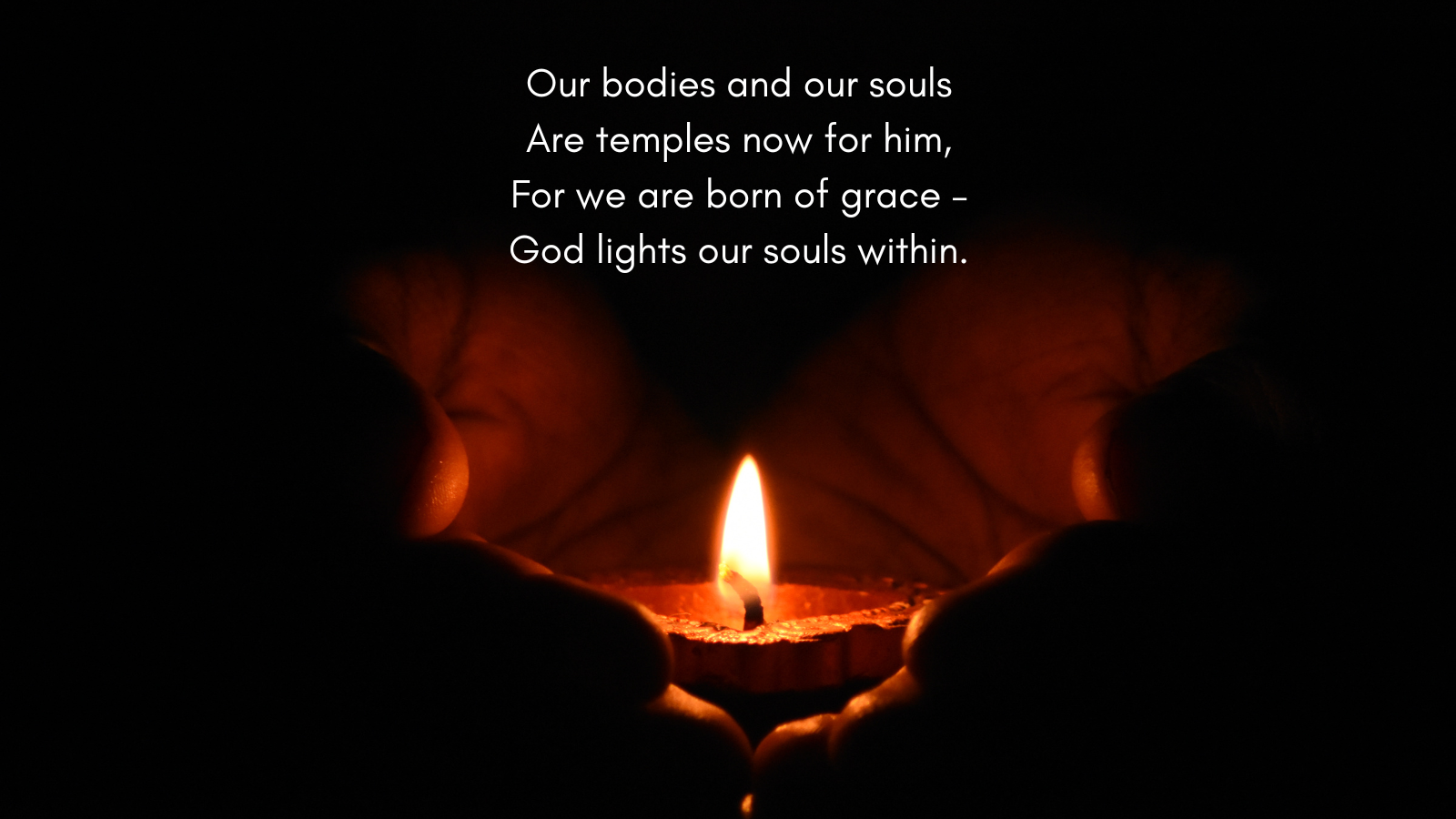
Our bodies and our souls
Are temples now for him,
For we are born of grace –
God lights our souls within.

O Light of all the earth!
We light our lives with thee;
The chains of darkness gone
All sons of God are free. 

The hymn opens with a scene that is fairly easy to picture: Mary and Joseph, a little travel weary, come in faithfulness to the Temple, clutching their precious child. I imagine them standing on the Temple threshold, breathing in the sacred. They are filled with that awe that we have all experienced when we enter a sacred place. I imagine Joseph holding the offering tight and Mary holding Jesus tight. The gift in Joseph’s hands represents the love and longing of every faithful Jew to fulfill the Torah. The gift in Mary’s hand represents the love and longing of everyone who looked forward to the coming of the Saviour.

Can we see ourselves in the scene? Can we picture our hands open with all that we hold precious?

The world’s true light draws near
All darkness to dispel

The promise of this light draws Simeon and Anna near. They have walked towards this light all their lives. Each prayer, each small act of kindness, each fulfilling of the Torah has made space inside them to recognise and receive the light. And there they stand, bathed in that light. God’s promises have come full circle.

Our bodies and our souls
Are temples now for him,

These are the lines that touch me most from this hymn. They speak of wholeness and the goodness of every created thing. Read alongside the Gospel text they invite each one of us to be that Temple. We build the Temple out of the many fragments of our lives. It’s incarnational. It’s messy. But the promise is there that we are ‘born of grace’ and God ‘lights our souls within’. We were carried once, a precious bundle held tight. Our parents made an offering of all they held dear when they brought us to church for Baptism. God’s light has always been within us.

We light our lives with thee;
The chains of darkness gone
All sons of God are free. 

In these days of darkness and uncertainty we might look outside ourselves for light. In fact, the light we seek is already within us. We often glimpse it in others first. Today’s feast is an invitation to celebrate the light within each one of us.

How is God calling you to celebrate the light this Candlemas?

With the Gospel for our guide…

Gospel Book,
Image: Copyright Turvey Abbey

Clothed then with faith and the performance of good works, let us set out on this way, with the Gospel for our guide, that we may deserve to see him who has called us to his kingdom.’ ( Prologue, Rule of St Benedict)

I entered the monastery in 1993 and so have consciously lived the cycle of the liturgical year 28 times. That’s a lot of exposure to Scripture. I’m often asked what drew me to the monastery. In truth, a big draw was the beauty of the Psalms and the way in which Scripture is woven throughout the monastic day.

As I have journeyed with the Gospels, I have come upon several books which have been an enormous help to me in digging deeper into the text. I am always on the look out for an interpretive key that can help me when I find the text difficult, or things seem to have gone a little dry.

THE GOSPEL OF MARK

One of my favourite finds is: The Spiritual Landscape of Mark’s Gospel, by Bonnie Thurston

Bonnie Thurston journeys through Mark’s Gospel exploring the symbolism of wilderness, desert, sea, valley etc. I found it a very helpful way to approach passages which have become very familiar to me.

You can read a sample here:

https://www.google.co.uk/books/edition/The_Spiritual_Landscape_of_Mark/H1BoSCSlGFEC?hl=en

Since my A Levels I have followed the work of scripture scholar Nicholas King sj. I chanced upon this unassuming little book in our library.

It’s 30 pages long and not a single word is wasted. (I am not sure if it is still in print.)

You can listen to Nicholas King on Mark’s Gospel here:

He has also produced a whole series of lectures on the New Testament which make very engaging listening. Nicholas King is very much a teacher and guides you through the texts in way that is fresh and often challenging. ( This is available on Amazon)

Belmont Abbey have recently produced a very good online retreat on Mark’s Gospel:

https://www.belmontabbey.org.uk/mysteries-of-markbb62732d

This material is very accessible and beautifully put together by Dom Brendan Thomas osb.

THE GOSPEL OF LUKE

Witness: Five Plays from the Gospel of Luke

Several years ago I came across these plays on Radio Four. I love the scope for the imagination that a radio play allows. I was captivated by the opening sentences voiced by Peter:

‘The lake means all to us. We’d starve without it.’

After each play there is a discussion with a panel of experts. These discussions gave me some helpful insights. (Available on Amazon)

THE GOSPEL OF JOHN

I have long been an admirer of the work of poet, priest and songwriter Malcolm Guite. Some years ago he gave a talk to my community entitled ‘Poetry and Prayer’. He is a captivating speaker and has a deep love for the Scriptures. He makes a great deal of his work available on his blog. I particularly recommend his talks on John’s Gospel which he as helpfully themed as Life, Light, Love and Glory.

You can listen to his talks here:

THE GOSPEL OF MATTHEW

Strangely, I can’t think of anything books that stand out for me on Matthew’s Gospel. This is not because of any difficulty with the text.

New Testament scholar Paula Gooder has a range of helpful material on the Gospels. I found this talk very good:

Her website has a wealth of resources:

Lastly, I have one recommendation for a good introduction to the Gospels: Beginnings, Keys that Open the Gospels, by Morna Hooker. I love her clear and fresh style. This book is a gem.

You can read a sample here:

https://www.google.co.uk/books/edition/Beginnings/rG5MAwAAQBAJ?hl=en

I hope you find something which inspires you in this round up.

Sr Miriam

O Emmanuel

December 23rd

Liturgy of the Word

Malachi 3:1-4, 23-24
Luke 1:57-66

O Emmanuel, king and lawgiver
desire of the nations,
Saviour of all people.
Come and set us free, Lord our God.

O Emmanuel

O come, O come, and be our God-with-us
O long-sought With-ness for a world without,
O secret seed, O hidden spring of light.
Come to us Wisdom, come unspoken Name
Come Root, and Key, and King, and holy Flame,
O quickened little wick so tightly curled,
Be folded with us into time and place,
Unfold for us the mystery of grace
And make a womb of all this wounded world.
O heart of heaven beating in the earth,
O tiny hope within our hopelessness
Come to be born, to bear us to our birth,
To touch a dying world with new-made hands
And make these rags of time our swaddling bands.

Malcolm Guite

Listen to Malcolm Guite read his sonnet:

O Rex Gentium

December 22nd

Liturgy of the Word

1 Sam 1:24-28
Luke 1:46-56

O King of all the nations,
the only joy of every human heart;
O keystone of the mighty arch of man,
come and save the creature
you fashioned out of dust.

O Rex Gentium

O King of our desire whom we despise,
King of the nations never on the throne,
Unfound foundation, cast-off cornerstone,
Rejected joiner, making many one,
You have no form or beauty for our eyes,
A King who comes to give away his crown,
A King within our rags of flesh and bone.
We pierce the flesh that pierces our disguise,
For we ourselves are found in you alone.
Come to us now and find in us your throne,
O King within the child within the clay,
O hidden King who shapes us in the play
Of all creation. Shape us for the day
Your coming Kingdom comes into its own.

Malcolm Guite

Listen to Malcolm Guite read his sonnet:

O Oriens

December 21st

Song of Songs 2:8-14
Luke 1:39-45

O Radiant Dawn,
splendour of eternal light,
sun of justice;
come, shine on those
who dwell in darkness
and the shadow of death.

O Oriens

First light and then first lines along the east
To touch and brush a sheen of light on water
As though behind the sky itself they traced
The shift and shimmer of another river
Flowing unbidden from its hidden source;
The Day-Spring, the eternal Prima Vera.
Blake saw it too. Dante and Beatrice
Are bathing in it now, away upstream…
So every trace of light begins a grace
In me, a beckoning. The smallest gleam
Is somehow a beginning and a calling;
“Sleeper awake, the darkness was a dream
For you will see the Dayspring at your waking,
Beyond your long last line the dawn is breaking”.

Malcolm Guite

Listen to Malcolm Guite read his sonnet: