O Adonai

Jeremiah 23:5-8
Matthew 1:18-24

O Lord of ancient Israel,
who showed yourself to Moses in the burning bush,
who gave him the holy law on Sinai mountain;
come, stretch out your mighty hand to set us free.

O Adonai

Unsayable, you chose to speak one tongue,
Unseeable, you gave yourself away,
The Adonai, the Tetragramaton
Grew by a wayside in the light of day.
O you who dared to be a tribal God,
To own a language, people and a place,
Who chose to be exploited and betrayed,
If so you might be met with face to face,
Come to us here, who would not find you there,
Who chose to know the skin and not the pith,
Who heard no more than thunder in the air,
Who marked the mere events and not the myth.
Touch the bare branches of our unbelief
And blaze again like fire in every leaf.

Malcolm Guite

Listen to Malcolm Guite read his sonnet:

How has God shown himself to you this Advent?

Which areas of your life do you most need God to set free?

Advent Alphabet (P)

PREPARE

PREPARE in the desert a way for the Lord.
Make a straight highway for our God across the desert.

Isaiah imagines for the Israelites a joyous return from Exile where their fortunes are to radically changed. In order that they waste no time the prophet tells them to prepare a straight highway. They have waited long enough in Exile, now they are to travel as quickly as possible from Babylon to Jerusalem. A straight road will help them do this.

Mark the Evangelist takes this text and puts it in the mouth of John the Baptist. The sense of urgency increases as John the Baptist calls for repentance, a change of heart.

When we hear this text in Advent it comes to us with all the urgency experienced by our ancestors in the faith. Amidst the physical preparations for Christmas we are invited to prepare our hearts for Christ’s coming. The liturgy can help us with this. It constantly calls us back to the things of the heart. The prophets call us to see the world as God sees it and to stand ready and prepared for when He comes.

What helps you to prepare and be ready in Advent?

(Isaiah 40:1-11, Tuesday, Week Two)

O Sapientia

17th December
O Sapientia

Gen 49:2, 8-10
Mat 1:1-17

O Wisdom, O holy Word of God,
you govern all creation
with your strong yet tender care.
Come and show your people
the way to salvation.

Today the Church silently selects her top liturgical gear. In the seven days before Christmas every collect, every antiphon and every piece of scripture has the sharpest of focus.

The days are shaped by the texts of the Magnificat antiphons which we sing each night at Vespers. Each antiphon highlights a title of Christ, our Messiah. The Latin names of the antiphons form an acrostic.

S apientia ( Wisdom)
A donai (Lord)
R adix Jesse (Root of Jesse)
lavis David (Key of David)

O riens (Rising Sun)
R ex Gentium (Ruler of the Nations)
E mmanuel (Emmanuel)

This spells the Latin words ero cras, I will be here tomorrow. It’s a beautiful way of keeping the last days of Advent.

Poet and priest, Malcolm Guite has written series of beautiful sonnets for the O Antiphons.

O SAPIENTIA

I cannot think unless I have been thought,
Nor can I speak unless I have been spoken.
I cannot teach except as I am taught,
Or break the bread except as I am broken.
O Mind behind the mind through which I seek,
O Light within the light by which I see,
O Word beneath the words with which I speak,
O founding, unfound Wisdom, finding me,
O sounding Song whose depth is sounding me,
O Memory of time, reminding me,
My Ground of Being, always grounding me,
My Maker’s Bounding Line, defining me,
Come, hidden Wisdom, come with all you bring,
Come to me now, disguised as everything.

Listen to Malcolm Guite read his sonnet:

https://malcolmguite.wordpress.com/tag/o-sapientia/

Advent Alphabet (O)

The Holy Spirit will come upon you, and the power of the Most High will OVERSHADOW you; therefore the child to be born will be holy; he will be called Son of God.

When the Moses and the Israelites wander in the wilderness they are re-assured by God’s presence, or glory, in the form of cloud by day and fire by night. It’s only Moses who is bold enough to ask to see God’s glory. It’s this glory which will fill the desert Tabernacle which the Israelites carry with them wherever they go. When the Temple is finally built, the Holy of Holies is the guaranteed dwelling place of God. In Judaism this presence is known as ‘shekinah’.

When we come to the story of the Annunciation and the angel’s words to Mary our biblical imaginations can draw upon the Old Testament thought world. That Mary will be ‘overshadowed’ by God’s power is a figurative way of saying that God will intervene directly. All of God’s power, presence, light, glory and love will be contained in Mary’s womb. This is a breathtaking promise. Mary is now the guaranteed dwelling place of God.

Needing to be re-assured of God’s presence is an experience in which we all share. People, places and rituals can give us a sense that God really is overshadowing our lives. Advent invites us deeper into that mystery.

Where have you felt God’s overshadowing presence this Advent?

(Luke 1:26-38, Dec 20th)

Advent Alphabet (N)

In the countryside close by there were shepherds out in the fields keeping guard over their sheep during the watches of the NIGHT.

Watching through the night is something which many of us will find ourselves doing at some point in our lives. We might be awaiting a birth or sitting at the bedside of a loved one in their last illness. There’s something about the darkness and the stillness that gives this time a very different quality to daytime. There’s an in built vulnerability, but also an uncluttered feel that can make space for problems to be resolved and new ideas to emerge.

Commentators suggest that it most likely springtime when these shepherds are keeping watch. Shepherds and sheep simply wouldn’t survive if this were winter. In Luke’s narrative these shepherds have a symbolic value. Watching through the night in order to guard their flocks from predators, they symbolise those who care for the vulnerable. This scene is in contrast to the world over which Caesar Augustus presides.

New Testament Scholar, Amy J Levine, imagines how the shepherds might spend their time:

We can picture these shepherds, under the stars. They are doing what people do at the end of the day: telling stories, singing songs, praying to God for good health or for the Romans to go away, talking about household joys and sorrows. Perhaps there are women among the shepherds, gathered together to tell their own stories and to share their own dreams.

On this night their watch through the night turns to wonder as the angels appear. In the darkness of the night they are caught up in glory.

How has God invited you to watch and wait this Advent?

Advent Alphabet (M)

MOUNTAIN

Come, let us go up to the
MOUNTAIN of the Lord,
to the Temple of the God of Jacob
that he may teach us his ways
so that we may walk in his paths…

In the opening chapters of Isaiah we find ourselves invited to ‘go up to the mountain of the Lord’. Mountains for Isaiah are metaphors and symbols of God’s promises. Isaiah’s world was chaotic, unjust and under constant threat of war. Into this world Isaiah speaks words of hope and a vision of unity. The mountain stands for a world that is better, where justice flourishes and there is no need for war. This mountain is Jerusalem, beloved city and place of holiness and hope.

For Isaiah, the secret to the peace and unity promised for those who make the journey up to the mountain of the Lord is the keeping of God’s law, Torah. This is where their hope lies. When they truly walk in God’s ways war will no longer be a possibility.

As war rages in Ukraine and bitter conflict continues between Hamas and Israel, we need a vision of peace more than ever. We can hold onto Isaiah’s hope that one day war will no longer be a possibility, while at the same time feeling helpless in the face of such endemic conflict. Our faith teaches us that every small act that fosters peace is not lost. God can use it all.

How can you foster peace in your family, workplace, community this Advent?

(Monday, Week One, Isaiah 2:1-5)

Advent Alphabet (L)

LOWLY

In your midst I will leave a humble and LOWLY people, and those who are left in Israel will seek refuge in the name of the Lord.

Israel’s story begins in obscurity, with no great fame or riches to guarantee its security or growth. Its faith is a tiny flame. Each step on the journey involves the protecting of that flame. For the flame of God’s plan to grow the humble and loving faith of a small group of people is needed. These are the ‘lowly’. The circumstances of their lives are such that they know their need of God.

In the Old Testament the lowly are known as the anawim. Sr Maria Boulding osb, in her book, The Coming of God’ explores their role in the story of salvation:

‘These anawim appear as the spiritual kernel of the nation from the seventh century BC. These were the have-nots, the underprivileged, the powerless, the oppressed, the people whose economic poverty drove them to unlimited trust in God.
The poor were the humble, the people who were obedient to the will of God, those whose very misery had forced their hearts open to him.’

God constantly entrusted himself in love to the people of Israel. Those who were poor and humble had space enough to receive him. They had lived lives of faithfulness to the Torah and could do no other than follow its commands.

Can you name the anawim in your own life?
What can they teach you?

(Tuesday, Week Three, Zephaniah 3:1-2. 9-13)

Advent Alphabet (K)

KINGDOM

As you go, proclaim that the
KINGDOM of heaven is close at hand.
Cure the sick, raise the dead,

cleanse the lepers, cast out devils

Through the Old Testament texts which we hear in Advent our biblical imaginations are reminded of the major themes in the story of our salvation. We hear again the promise that a time of sorrow is to be ended and that a new life awaits the Israelites. This new life is to be full of reversals: tears will be wiped away and mourning turned to joy, nations will turn the implements of war into agricultural tools, the lame will leap and all will enjoy a lavish banquet. A child will be born who will embody every virtue of the perfect King. Integrity and good government will be assured. God’s Kingdom will be established in peace and security.

When Matthew writes his Gospel he too tells the story of the Kingdom. Where the Old Testament prophets promised a new world order, Matthew now points to Jesus as the living embodiment of the Kingdom. The disciples are called and tasked with this vision too. The disciples are to proclaim the Kingdom in word and deed. They will seek out those who are in need. Little by little glimpses of a new world order will be seen.

We need to hear this message more than ever in our world today. Situations of endemic conflict weigh on our hearts. Holding fast to the vision of the Kingdom takes as much hope and faith now as it did for our ancestors.

Where have you glimpsed the Kingdom this Advent?

(Matthew 9:35-10:1.6-8)

Advent Alphabet (J)

JOY

I’ve prayed the Psalter for almost thirty years. The poetry and the rhythm of our singing have the effect of, little by little, altering my inner landscape. Just about every human emotion is to be found in the Psalms. ‘Joy’ makes a frequent appearance along with ‘delight’ and ‘exultation’. The Books of Isaiah are written in a style which reminds me of the Psalms. Hard-hitting rhetoric about Israel and Judah’s failure to walk in the way of the Lord is woven together with some of the most exultant words in Scripture.

Isaiah tells of a great reversal of fortunes: the people will leave behind the wilderness experience of Exile and run to the safety and security of Zion. The whole cosmos will share in the joy of God’s saving act. This is no fleeting joy, this joy is everlasting. Every fibre of their being will be filled with joy.

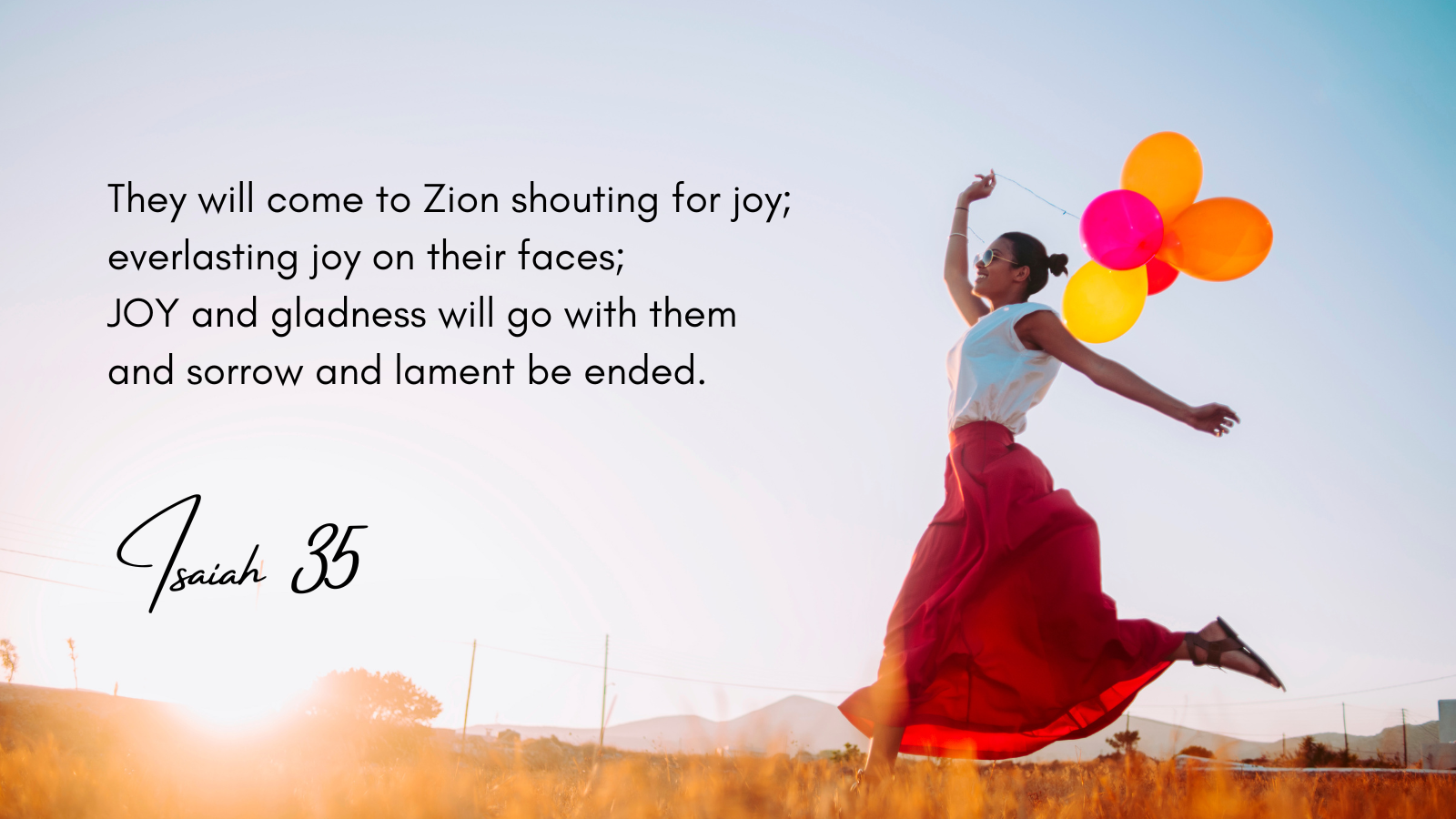
They will come to Zion shouting for joy;
everlasting joy on their faces;
JOY and gladness will go with them
and sorrow and lament be ended.

It’s easy to lose sight of this prophetic promise in our own lives. It is into our own world, with all its joys and sorrows, that Isaiah still speaks his promise. What is dry and arid God promises to renew with an everlasting joy. Advent invites me to be consciously open to those moments of joy.

Where have you experienced joy this Advent?

(35:1-10 Monday, Week Two)

Advent Alphabet (I)

Have a care for justice, act with INTEGRITY, for soon my salvation will come and my integrity be manifest.

Amidst the necessary preparations for Christmas it is very easy to lose sight of the many prophetic calls that are found in the Liturgy of the Word for Advent. In the texts from the three Books of Isaiah, though they are written in different time periods, there is a strong and insistent voice that calls for an integration of worship, behaviour and attitudes. Isaiah warns against honouring God with your lips while you cheat the poor.

When the writer of the Third Book of Isaiah calls for integrity it is a radical call to ‘bind in mutuality the strong and the weak, the rich and the poor. The intent is to assure every member of security, dignity and well being.’ (Walter Brueggemann) Isaiah’s vision is one of right ordering.

In the Gospel texts which we read during Advent we walk alongside Jesus as he preaches and heals. We walk alongside Jesus as he brings the ‘right order’ of the Kingdom. Jesus models for us the integrity which we seek.

How is God calling you to integrity this Advent?

(Isaiah 56:1-3, 6-8, Friday, Week 3)