What do you hear in Sarah’s description of being in Jerusalem for Passover? Have you ever made a pilgrimage? What did you learn about yourself.?
When Sarah listens to Jacob’s experience in the Temple she shares his love of the Law and the debates that are had. What the questions that you would like to raise about your own faith? Do you have places where you can do this?
Each morning he wakes me to hear, to listen like a disciple. The Lord has opened my ear.
As we begin Holy Week the Church invites us on a journey. This week is like no other in the year. The Church tells her story in words and images, in ritual and drama, and in silence and song. We are invited to find ourselves in the scriptural stories.
The First Reading for today from Isaiah 50 can be a helpful starting place for the week. The servant knows himself as a disciple. Each day his task is to hear what God is saying. God has already created in him an openness and a readiness. God has opened the servant’s ear. I hear this as promise that God will speak to us.
Make a conscious effort this week to listen to God in the scriptures and those around you.
I shall make a covenant of peace with them, an eternal covenant with them. I shall resettle them and increase them; I shall settle my sanctuary among them for ever.
We have met the prophet Ezekiel already during Lent. Woven together with warnings and reminders of just how much Israel has strayed are some of the most memorable prophecies of hope in all of the prophetic literature. Today we hear a promise of gathering together and of unity. Israel has suffered the hardship of being scattered physically in Exile. It had also suffered a kind of fracturing of the heart as it left behind all that it held dear in life and worship. God’s promise is far-reaching and will heal their inner and outer fragmentation. God offers them a covenant of peace.
Covenants are two-way. Israel has her part to play in this new stage of her relationship with God. What is asked is faithfulness in every area of their lives. Nothing is outside God’s remit.
As we get closer to Holy Week there is a sense of growing tension in every encounter that Jesus has. He is challenged on every level and his responses only add to the confusion of his hearers. Today he makes a very simple appeal: if you don’t believe in me, at least believe in what I am doing.
If I am not doing my Father’s work, there is no need to believe me; but if I am doing it, then even if you refuse to believe in me, at least believe in the work I do; then you will know for sure that the Father is in me and I am in the Father.’
The complexity of so many situations in the world today has focused our attention on governments and their leaders. I think there are many who serve us in public office who would want us to believe in them. We’ve grown weary of some styles of leadership and are less than impressed with what they do. In short, we don’t believe in them or what they do.
The words of Jesus challenge us to live in such a way that others can see God at work in us. Sometimes this will be through the practical things that we do. Sometimes it will be through the subtlety of inner work. One can help the other.
How can you live so that others can see God’s work in you?
Using the responsorial psalm verse as a repeated prayer or mantra can often be a very helpful way into the Liturgy of the Word. It’s especially helpful today as the theme of covenant links our readings. God’s faithfulness to us and our faithfulness to God is the foundational to the story of our salvation. We can trace a path through the Scriptures of God’s desire to reach out in love to the whole of humanity.
In the first reading from Genesis God pledges his faithfulness to Abraham:
I will establish my Covenant between myself and you, and your descendants after you, generation after generation, a Covenant in perpetuity, to be your God and the God of your descendants after you.
Time and time again God will remind the people of Israel of this bond.
In the Gospel today Jesus confounds his hearers by declaring ‘before Abraham came to be, I AM.’ The Pharisees hear this literally. What Jesus is saying is that every covenantal promise made to Abraham and every generation thereafter comes to fulfilment in Him. This is blasphemy to their ears. It’s easy to scapegoat the Pharisees and pat ourselves on the back because we can grasp what Jesus is saying. The invitation to the Pharisees and to us today is one and the same: live lives of faithfulness and love that the world may believe.
In the remaining days of Lent how can you live in faithfulness?
In much of John’s Gospel Jesus speaks to people who struggle to understand him. He speaks figuratively and his hearers assume he is being concrete. We, however, are so used to quotations from the Gospels and usually can grasp their meaning.
‘If you make my word your home you will indeed be my disciples, you will learn the truth and the truth will make you free.’
From our vantage point, the quotation from today’s Gospel could be seen as the Gospel in microcosm:
inhabit the Scriptures, grow in discipleship, learn the truth, experience freedom.
Our starting place is so clear. Get to know the Scriptures, make them your home and feel at home with them. This is a very personal journey. In every page of the Scriptures God speaks to our hearts.
Use your Bible today. Find your favourite quotations.
Each year as we get closer to Holy Week I find that the readings are a little more complex than those we read in the early weeks of Lent. The texts from John’s Gospel ask a little more of me. John writes in a register which I feel requires me to hold together several layers of meaning at once.
Today’s first reading from Numbers is the story of the people being bitten by snakes in the wilderness. Moses fashions a bronze serpent, holds it up and whoever looks upon it lives. Whatever we might think of the likelihood of this happening, the point the story is the power of God to heal and save.
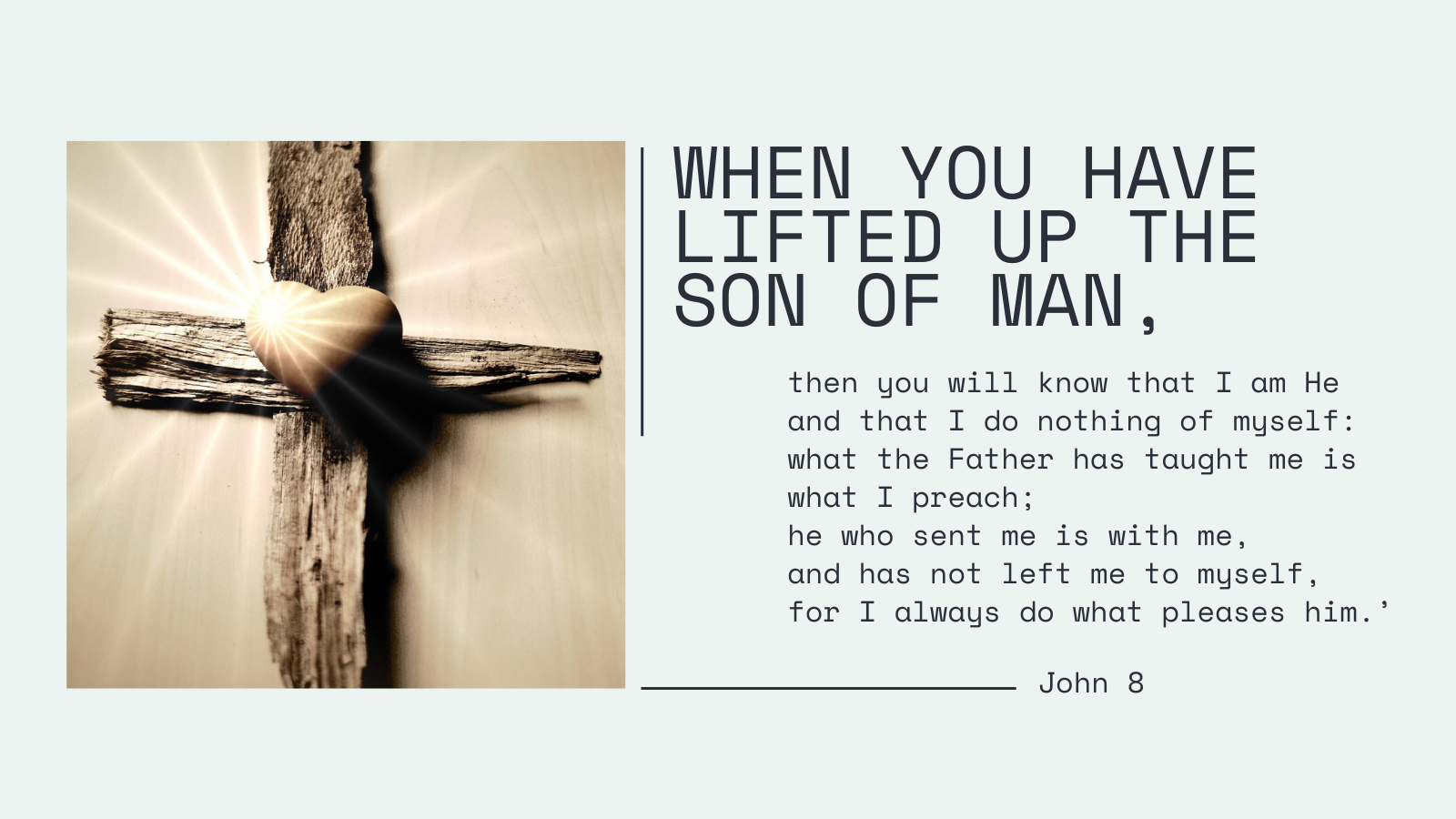
Moses’ holding up the serpent links directly with John’s important theological idea of Jesus being ‘lifted up’ on the cross. Jesus is presented as the one who brings healing through suffering and glory. When Jesus is lifted up people will see that his claims about his close relationship with his Father are true.
In today’s Gospel the Pharisees are determined to trap Jesus. The Pharisees are studiers of the Law in all its beauty and power. They want to see the way ahead, but just can’t. They take Jesus literally when he speaks. This isn’t quite enough.
Jesus changes tack and speaks of his relationship with his Father. In the most intimate of language we hear that Jesus and the Father are one and that Jesus does ‘what pleases him.’ The Pharisees still can’t understand.
‘what the Father has taught me is what I preach; he who sent me is with me, and has not left me to myself, for I always do what pleases him.’
Doing what pleases God is a hard daily task. The Jesuits have a helpful way of looking at this and speak of ‘wanting to want what God wants’. I can manage this.
As we move towards Holy Week there is a sense of growing tension in our Gospel texts. Jesus’ actions are being watched very closely and every word of his teaching is being scrutinised. Vigorous debate and cross questioning were an important part of the faith world of Jesus. It’s easy to forget this when we see him being confronted in the Temple. Jesus often replies in ways that must have been shocking to his hearers. To declare himself the light of the world is the boldest of claims.
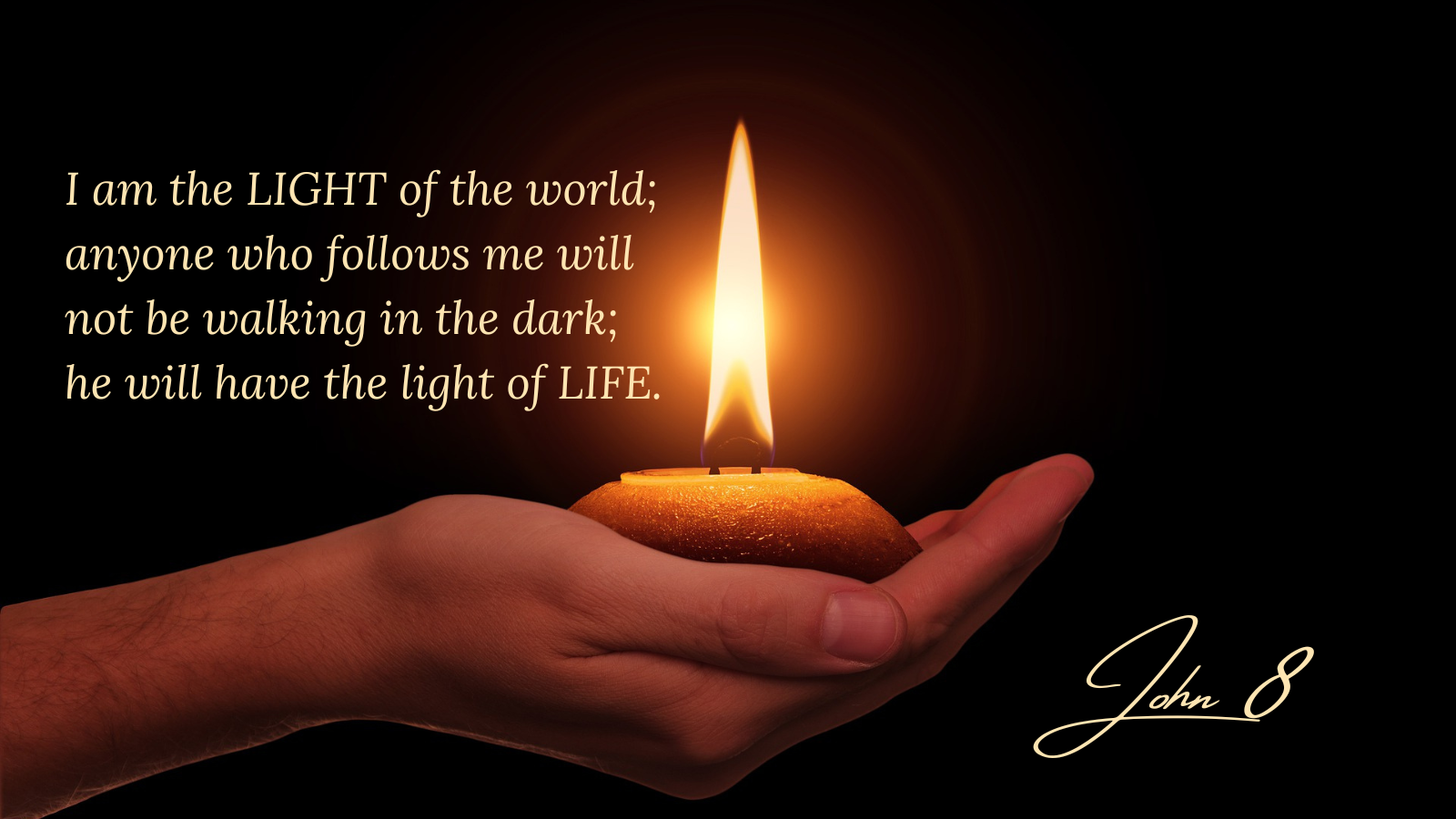
I am the LIGHT of the world; anyone who follows me will not be walking in the dark; he will have the light of LIFE.
We see this quotation on posters and prayer cards and we sing it in our hymns. It comforts us. But does it challenge us too? What would it mean for us to really follow Christ? What would it mean for us to have the light of life? What would it mean for us to have all that we do and say flooded with Christ’s light?
At baptism our parents and godparents stood around the font holding candles which had been lit from the Paschal candle. They put their hope in Christ who is our light. They pledged that you and I would always walk in that light.
Light a candle today and thank God for the blessings you received at Baptism.
As we get closer to Holy Week the liturgy builds in intensity. We have journeyed with Jesus from desert to mountain top and we have heard his invitation to turn our hearts to God, to bear fruit for his Kingdom. And now the Church puts before us a story that invites us to examine our own hearts and minds.
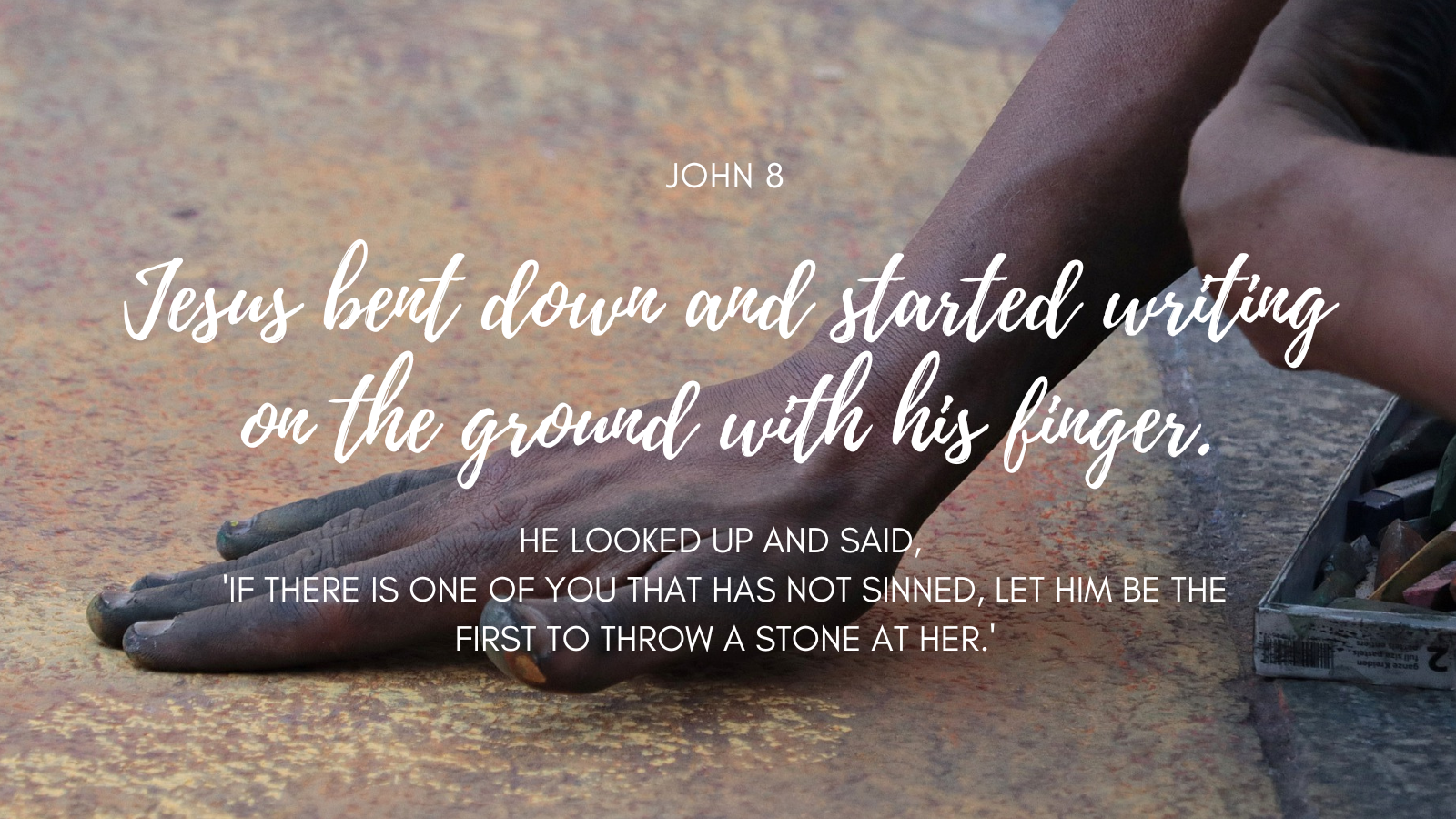
This is perhaps one of the most tender encounters in all of the Gospels. We picture the uncomfortable scene of a woman brought by the Pharisees to Jesus. In the eyes of the crowd she is in disgrace. But Jesus diffuses a situation, shifting the focus away from the woman and writing in the dust. With this simple action he makes space for the woman. He makes a frightening situation safe for her. We will never know what he wrote. And this, for me, makes the encounter all the more tender.
I like to think that for the woman this encounter was life-changing. Not only for the compassion that she was shown, but also because Jesus saw her and made space for her. I wonder could the woman make the words of today’s Psalm (125) her own: ‘What marvels the Lord worked for us! Indeed we were glad.’ Would she see herself as going out ‘full of tears’ and coming back ‘full of song’? I hope so.
Jesus stands before the woman as an embodiment of the marvels that God can work. As I reflect on the story I find myself wondering where I stand. Do I stand with the crowd? Do I stand with Jesus? Do I stand with the woman? Do I stand with the teachers of the law and the Pharisees?
Although I’d like to imagine myself always standing with Jesus and the woman, I need to acknowledge those times when judgment looms large for me. Lent gives us the chance to look again at our assumptions and judgments.
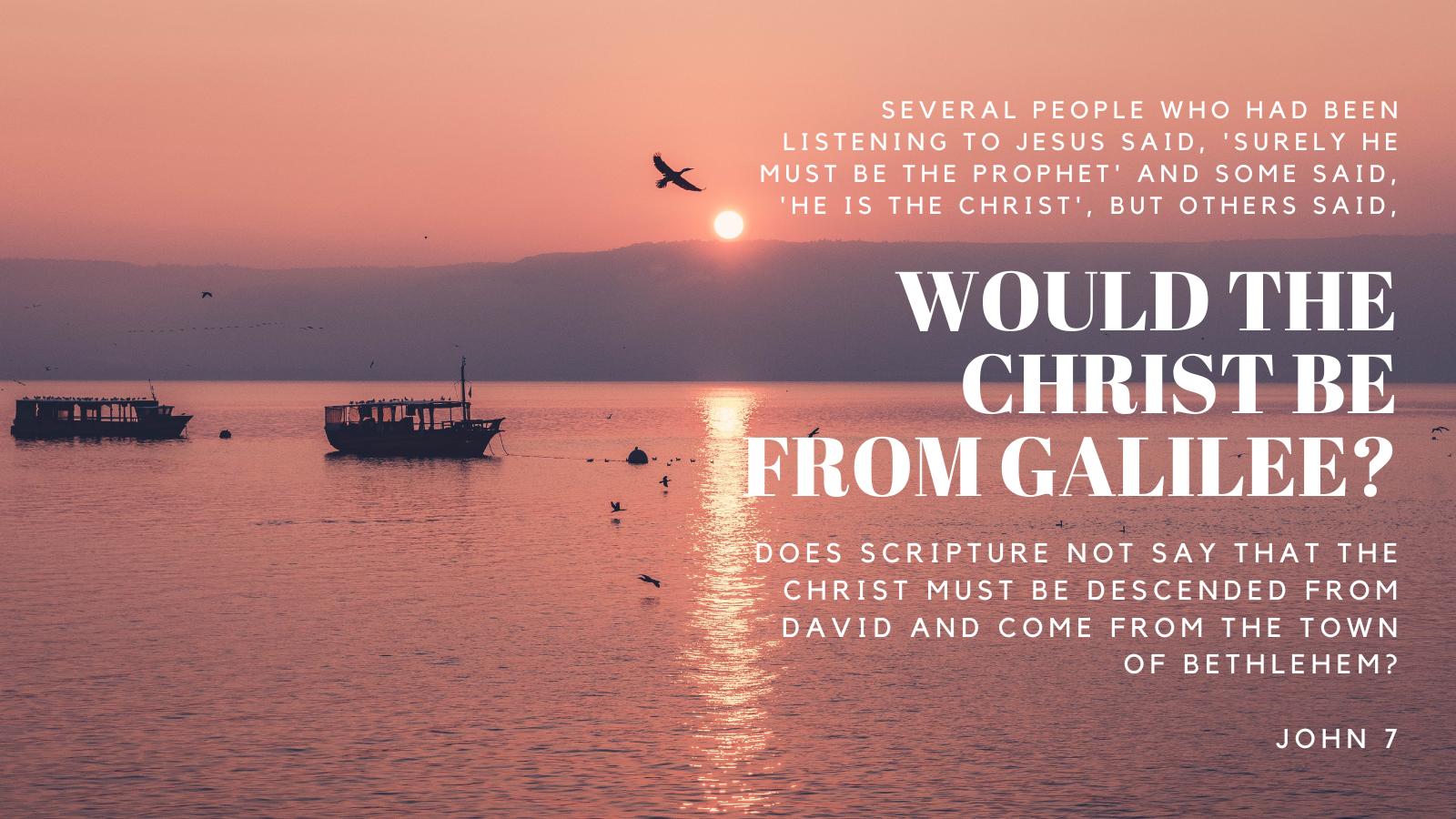
Where you come from seems to matter a great deal in the Bible. It’s not just your town or village that is under scrutiny, but your parents too. In its best light this is about being able to trace the path of God’s promise.
The promise of the Messiah, the Anointed One, gives the people great hope. For those who anticipated a powerful political Messiah the idea that he could come from the relatively obscure town of Galilee would seem almost ridiculous. They have read the biblical sources in such a way so as not to be able to recognise Jesus as the Messiah.
We read the text with hindsight knowing only too well how things are engineered so that Jesus is actually born of David’s line and in Bethlehem. This requires two plot twists for God’s plan to be fulfilled.
Being able to see the way in which God has worked in the past can help you make sense of the present and encourage you to look to the future with hope. It isn’t always easy to see the hand of God in our own lives or to see or hear some things as prophetic. Often its only in looking back that we glimpse God.
Reflect on your faith journey. How has God been at work in your life?