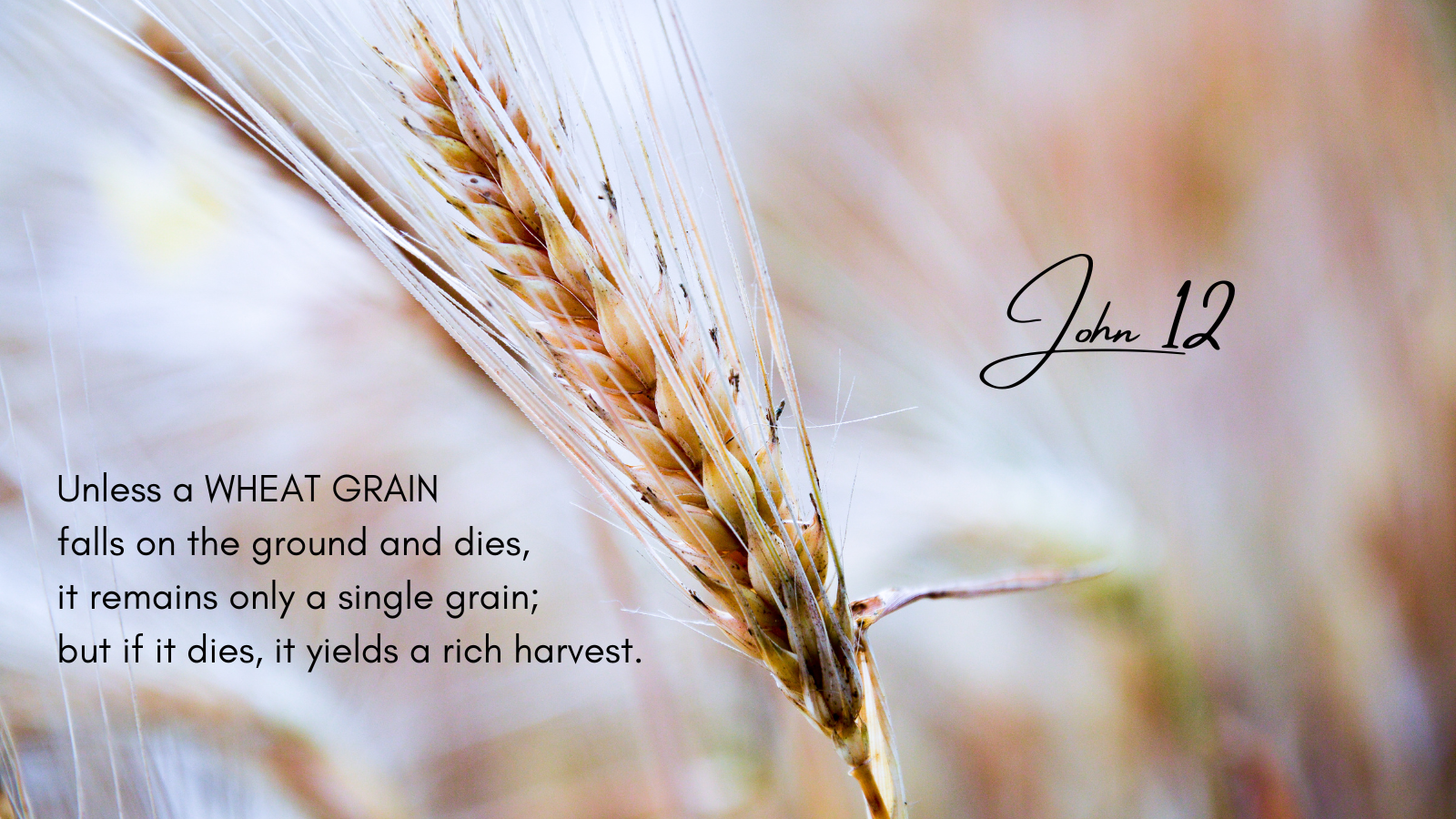
WHEAT GRAIN
Unless a WHEAT GRAIN falls on the ground and dies, it remains only a single grain; but if it dies, it yields a rich harvest.
As we come to the final weeks of Lent we might feel that our hopes and plans haven’t quite come to fruition. The Liturgy can gently nudge and prompt us to go a little deeper. It can also shock us into action too. This text from John’s Gospel always prompts me to go a little deeper. The imagery draws me in and I imagine fields and fields of golden wheat, stretching as far as the eye can see. It isn’t long before I am faced with the reality of what it means for a wheat grain to fall to the ground and die. As the wheat grain dies, so must I die to self.
On Holy Saturday at Lauds we sing these verses from the Byzantine liturgy:
How can you die, Christ our Life,
How can you lie in the tomb?
How can you die, Christ our Life,
How can you lie in the tomb?
By your death, you will destroy the power of death,
And you will raise the dead from their tombs.
Lord, you were like a wheat grain in the heart of the earth.
Lord, you were like a wheat grain in the heart of the earth.
The grain dies and the wheat springs up a hundredfold;
truly, you are our Bread and our Life.
In the starkness of our chapel on Holy Saturday these words go straight to the heart. Daunting as it may feel to confront the reality of dying to self, this pattern of dying and rising has already been imprinted on each of us at baptism. We are sealed and strengthened with Chrism and called to pattern our lives on Christ as priest, prophet and king. We carry within us the potential to die to self and embrace new life. Lent sharpens our focus. Each Lent the invitation is the same.
Which opportunities has Lent given you to die to self and to embrace new life?
(John 12: 20-33, Fifth Sunday in Lent)